Growing Herbs Indoors: Light, Soil and Water
Growing herbs indoors is a practical way to enjoy fresh flavors throughout the year, even if you do not have a traditional garden. A bright kitchen windowsill, sunny room, or small shelf with suitable grow lights can provide space for herbs such as basil, parsley, mint, chives, thyme, and oregano.
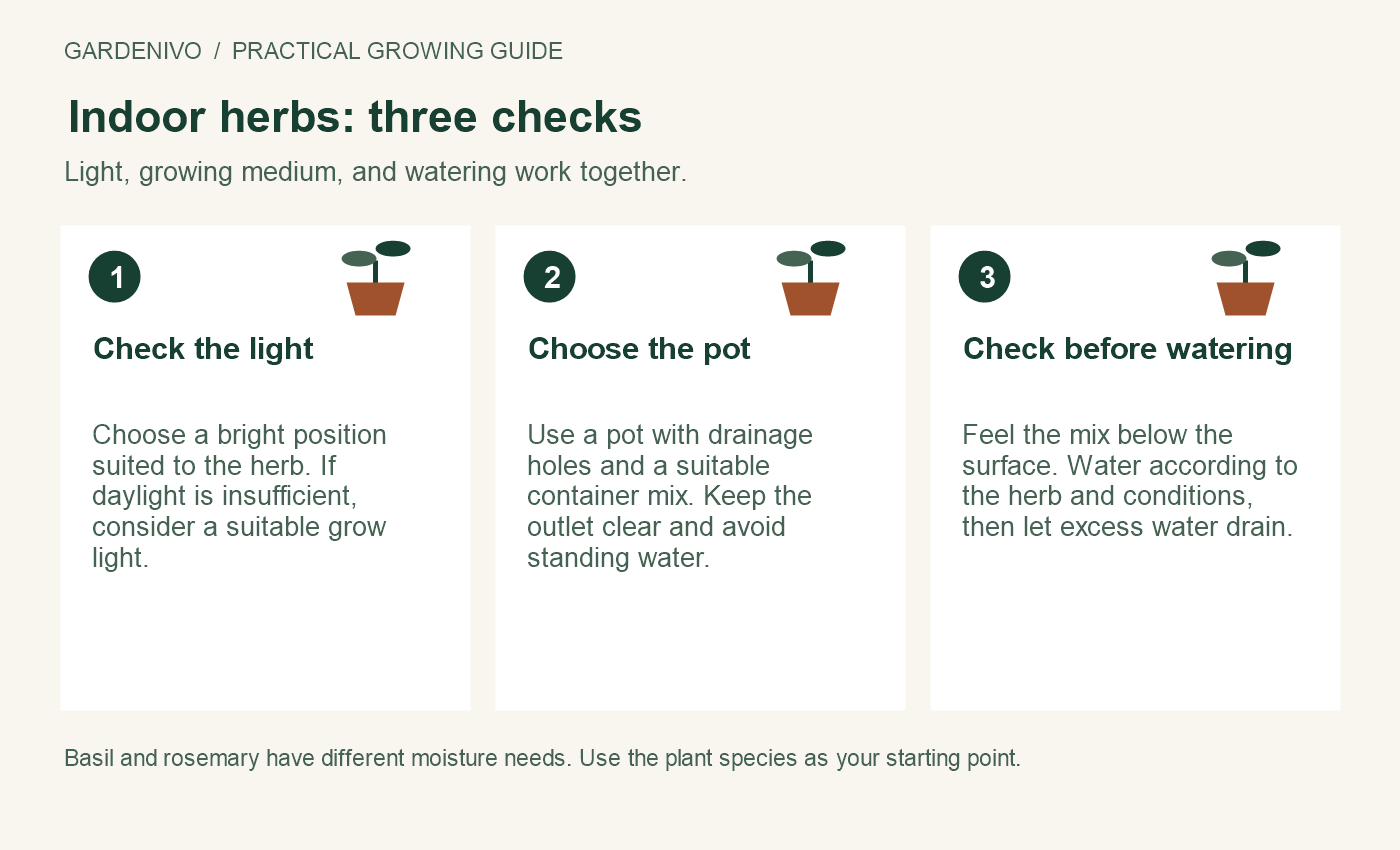
However, growing herbs inside a home is not always as easy as placing a few pots near a window. Indoor light levels are usually lower than outdoor sunlight, containers have limited root space, and potting mix can remain too wet or become excessively dry. For help choosing what goes in the pot, compare potting mixes for herbs and other plants.
Different herbs also have different growing requirements. Basil prefers warmth and a reasonably consistent supply of moisture, while rosemary and thyme generally benefit from stronger light and a more freely draining growing medium. Mint tolerates somewhat less direct sunlight than many Mediterranean herbs but still needs enough light for healthy indoor growth.
Successful indoor herb gardening begins with choosing suitable plants, providing sufficient light, using the right potting mix, and watering according to actual root-zone moisture. Regular harvesting and sensible feeding can then help maintain productive plants.
This guide explains how to grow culinary herbs indoors, from selecting plants and positioning containers to using artificial lights, managing soil moisture, and preventing common problems. You’ll also learn how to harvest herbs without weakening them and how to troubleshoot yellow leaves, leggy growth, root problems, and other symptoms.
Quick Answer: How Do You Grow Herbs Successfully Indoors?
To grow herbs indoors successfully, choose varieties suited to containers, place them where they receive sufficient light, use a well-draining potting mix, and water according to the needs of each plant.
Most culinary herbs grow best with around six hours or more of direct sunlight per day. If indoor sunlight is inadequate, a suitable grow light can provide supplemental illumination. Many indoor herb-growing systems use approximately 12–16 hours of artificial light daily, depending on light intensity and plant requirements.
Use pots with functional drainage holes and a lightweight growing medium. Water when moisture in the active root zone becomes insufficient rather than following a fixed daily schedule.
For beginners, the most important steps are:
- Choose manageable herbs: Basil, parsley, chives, mint, and thyme are useful starting choices when their growing conditions can be met.
- Provide strong light: Use a bright, unobstructed window or suitable supplemental grow lights.
- Use the right potting mix: Choose a lightweight medium that balances drainage and moisture retention.
- Include drainage holes: Allow excess water to leave the container.
- Check moisture before watering: Different herbs need different degrees of drying between applications.
- Maintain suitable temperatures: Protect tender herbs from cold windows, drafts, and excessive heat.
- Harvest gradually: Remove leaves or shoot tips without stripping the plant excessively.
- Feed appropriately: Use modest fertilizer applications only when necessary for active growth.
- Monitor for pests: Inspect leaves, stems, and the growing medium regularly.
- Adjust care seasonally: Indoor light and water demand change throughout the year.
Indoor herbs can be harvested throughout the year under suitable conditions, but production may slow during periods of weak light or reduced growth.
Gardening Tip: Start with two or three herbs rather than filling an entire windowsill immediately. Basil, parsley, and chives can make a useful beginner collection. Learn how their light and watering needs differ before adding more demanding plants.
What Are the Best Herbs to Grow Indoors?
Many culinary herbs can grow indoors when they receive suitable light, temperature, moisture, and root space.
Some are naturally compact, while others become relatively large or need frequent replacement to maintain a useful harvest.
Basil
Basil is a popular culinary herb for indoor kitchens because its aromatic leaves can be harvested regularly.
It prefers warmth, strong light, and a growing medium that drains well without drying severely during active growth.
Under weak light, basil may produce long, thin stems and smaller leaves.
Parsley
Parsley is useful in cooking and can adapt to bright windowsills or suitable artificial lighting.
It grows best in a well-drained medium with adequate moisture and sufficient root depth.
Parsley is a biennial plant, commonly grown for its leaves during the first part of its life cycle. Leaf quality and production often decline as it begins flowering.
Mint
Mint can grow vigorously in suitable containers and often tolerates somewhat less direct sunlight than herbs such as rosemary and thyme.
It prefers reasonably consistent moisture and a sufficiently large pot for its spreading root system.
Growing mint separately helps prevent it from overwhelming smaller herbs.
Chives
Chives have narrow, onion-flavored leaves and a compact growth habit that makes them suitable for indoor containers.
They benefit from bright light and moderately moist, well-draining growing media.
Chives can also regrow after harvesting when enough healthy foliage and energy reserves remain.
Cilantro or Coriander
Cilantro is grown for its fresh leaves, while the term coriander often refers to the same plant or its dried seeds, depending on the region.
It prefers bright conditions and can tolerate somewhat cooler temperatures than basil.
Because cilantro may flower and set seed relatively quickly under unsuitable temperatures or other stress, repeated sowing can provide a more consistent supply of fresh leaves.
Rosemary
Rosemary is an aromatic evergreen herb that prefers strong light and freely draining growing media.
It can be more challenging indoors because insufficient light, poor drainage, or inappropriate watering may cause decline.
Rosemary is often better suited to a very bright location or a suitable grow-light setup than a dim kitchen corner.
Thyme and Oregano
Thyme and oregano are useful culinary herbs that typically prefer bright light and well-draining soil.
Once established, they usually tolerate more drying between waterings than herbs such as basil or mint.
They should not be left continuously saturated in an effort to keep the leaves green.
How Much Sunlight Do Indoor Herbs Need?
Insufficient light is one of the most common reasons indoor herbs produce weak, leggy growth.
Most culinary herbs naturally grow outdoors under relatively bright conditions. Indoor rooms often provide much less light, even when they appear bright enough for everyday activities.
Aim for a Bright Window With Direct Sunlight
Many herbs perform best with approximately six hours of direct sun per day, although individual species vary.
Rosemary, thyme, and basil are particularly likely to struggle when light is inadequate.
Chives, mint, parsley, and cilantro may tolerate somewhat less direct sunlight under suitable conditions, but deep shade can still reduce their growth.
Choose the brightest unobstructed window available without exposing sensitive plants to extreme temperatures.
Which Window Direction Is Best?
In the Northern Hemisphere, a south-facing window often receives strong sunlight during much of the year.
In the Southern Hemisphere, a north-facing window generally offers comparable sun exposure.
East- and west-facing windows may also be suitable, depending on the time of year, nearby buildings, trees, and the herb species.
Observe the actual amount of direct sunlight reaching the plants rather than relying only on compass direction.
How to Recognize Insufficient Light
Indoor herbs receiving too little light may show:
- Long, thin stems with large spaces between leaves.
- Leaves that are smaller or paler than expected.
- Plants leaning strongly toward the window.
- Slow growth and limited new foliage.
- Reduced fragrance or flavor intensity in some herbs.
- Weak stems that cannot support normal growth.
These symptoms can overlap with temperature, root, or nutrient problems, so examine the entire growing environment before changing the care routine.
Rotate Containers for Even Growth
When light enters mainly from one direction, stems may lean toward the window.
Rotating pots periodically can help expose different sides of the plant to available light.
However, rotation does not compensate for insufficient overall light intensity.
How to Grow Herbs Indoors With LED Grow Lights
Grow lights are useful when natural sunlight is insufficient, especially during short winter days or when windows are shaded by buildings.
A suitable artificial lighting setup can support herb growth on a kitchen shelf, dedicated plant stand, or other appropriate indoor growing area.
Choose Lights Designed for Plant Growth
Modern LED grow lights are commonly used because they can provide useful light intensity while producing relatively little waste heat compared with some older lighting systems.
Choose a light from a reliable manufacturer with information about coverage area, power, recommended mounting height, and plant-light output.
Full-spectrum white LED grow lights are a practical option for many home herb gardens.
A regular decorative room lamp may not supply enough useful light, even when it appears bright to the human eye.
How Many Hours Should Grow Lights Stay On?
Many indoor herb-growing recommendations suggest approximately 12–16 hours of suitable artificial illumination per day.
The exact duration depends on light intensity, the plant species, and whether daylight also contributes to the total light received.
With weaker artificial lighting, a longer daily period may be required. Stronger, properly designed plant lights can deliver an adequate daily amount of light in a shorter period.
Plants also benefit from a regular dark period. Do not leave grow lights switched on continuously for 24 hours as a routine practice.
A timer can help maintain a consistent light-dark cycle.
How Far Should Grow Lights Be From Herbs?
The correct distance varies greatly between LED fixtures.
Some compact herb-growing lights are designed to sit relatively close to the foliage, while stronger units require greater separation.
Follow the manufacturer’s recommended distance and adjust as the plants grow.
If plants stretch toward the light, they may not be receiving enough usable illumination. If leaves become bleached, scorched, or unusually stressed close to a powerful fixture, review the intensity and positioning.
Do Herbs Need Expensive Grow Lights?
Not necessarily. A small herb collection may grow successfully under a suitable compact LED fixture, provided it delivers enough light over the growing area.
However, an inexpensive lamp with insufficient output may produce disappointing growth regardless of how long it remains switched on.
Choose equipment according to the number of plants, the available space, light coverage, energy use, and manufacturer specifications.
Grow-Light Safety
Keep lights, electrical connections, and power supplies away from spilled irrigation water.
Use fixtures according to their electrical safety instructions, provide suitable ventilation, and secure shelves and lights properly.
Protect children and pets from exposed wiring, unstable equipment, and hot components.
What Is the Best Soil for Growing Herbs Indoors?
Indoor herbs need a growing medium that provides enough moisture and nutrients while allowing excess water to drain and oxygen to reach their roots.
For most beginners, a suitable commercial container potting mix is a more reliable choice than ordinary garden soil.
Use Lightweight Potting Mix
Commercial potting mixes may contain coconut coir, composted bark, peat or peat-free alternatives, perlite, and other ingredients.
These components are combined to provide suitable structure, moisture retention, and drainage.
A good herb-growing medium should not become excessively compacted after watering.
It should also retain enough water to prevent sensitive roots from drying immediately after irrigation.
Why Ordinary Garden Soil Is Usually Not Ideal
Garden soil can become dense inside a pot, particularly when it contains substantial clay.
Poorly aerated soil can remain saturated and restrict normal root function.
Garden soil may also introduce weed seeds, insects, or plant pathogens into the home.
Use a properly formulated growing medium designed for containers rather than filling indoor herb pots with unmodified garden soil.
Different Herbs Need Different Moisture Retention
Basil, parsley, and mint generally benefit from a growing medium that retains useful moisture without becoming waterlogged.
Rosemary, thyme, sage, and many Mediterranean herbs usually need a more freely draining growing environment.
For suitable plants, adding horticultural perlite, pumice, or another appropriate aeration material can help make a potting mix more open.
However, adding excessive coarse material can cause the medium to dry more quickly than some herbs tolerate.
Choose a balanced mix based on the herb rather than making every container drain as quickly as possible.
Does Potting Mix Need Fertilizer?
Some commercial growing media include starter fertilizer or controlled-release nutrients.
Others contain relatively few available nutrients and require an appropriate feeding program as the plants grow.
Read the product label before adding fertilizer to avoid unnecessary nutrient accumulation.
Choosing Pots and Providing Good Drainage
The right pot supports healthy root growth and helps maintain appropriate moisture conditions.
Choose a container that provides enough room for the herb without surrounding a small root system with an unnecessarily large volume of wet growing medium.
Always Check Drainage Holes
Most ordinary indoor herbs grow best in containers with functional drainage holes.
These allow excess water to leave the pot after irrigation.
Decorative outer pots can be used if the plants remain in separate draining inner containers.
Empty excess water from outer pots and saucers rather than leaving roots submerged.
What Pot Size Should You Use?
Container size depends on the herb’s root system and expected mature growth.
Small young herbs may begin in pots approximately 10–15 cm (4–6 inches) wide and be moved to larger containers as their roots develop.
Vigorous mint, mature rosemary, and large parsley plants often benefit from more generous root space than very young basil seedlings.
These dimensions are starting points rather than fixed requirements. Choose pots according to the actual plant and its root development.
Terracotta vs. Plastic Pots
Unglazed terracotta pots are porous and allow some moisture to evaporate through their walls.
This can help the growing medium dry more quickly, which may suit certain Mediterranean herbs.
Plastic pots typically retain moisture longer because their walls are less porous.
Both materials can work well if drainage holes, potting mix, and watering are appropriate.
Do Not Add Gravel at the Bottom
Placing a gravel layer beneath the potting mix does not reliably improve drainage.
Water can remain suspended in the finer growing medium immediately above the coarse layer, increasing the depth of saturated medium near roots.
Use a suitable potting mix throughout the container instead.
How Often Should You Water Indoor Herbs?
Indoor herbs should be watered according to their species, growing-medium moisture, container size, and environment rather than a universal daily schedule.
The same herb may need water much more frequently during warm, bright weather than during a cool period with limited sunlight.
Check Soil Moisture With Your Finger
For a simple starting test, insert your finger approximately 2.5 cm (1 inch) into the growing medium.
If it feels dry near the active roots, consider whether the herb needs water.
If the medium remains damp, delay unnecessary watering.
For larger pots, examine moisture deeper in the root zone, as the surface may dry before the lower growing medium.
Basil, Mint, and Parsley
These herbs generally benefit from adequate, reasonably consistent moisture during active growth.
Avoid letting the growing medium become severely dry for extended periods.
However, consistent moisture does not mean leaving the roots permanently saturated.
Allow excess water to drain and check the soil before the next application.
Rosemary, Thyme, Sage, and Oregano
These herbs generally tolerate more drying between waterings than basil or mint.
They are especially vulnerable to problems when the growing medium remains excessively wet for long periods.
Allow the upper portion of the potting mix to dry appropriately, while avoiding prolonged severe drought that damages the root system.
Rosemary can be particularly sensitive to both prolonged saturation and extreme drying in containers, so monitor it carefully.
Water Thoroughly When Needed
When watering is appropriate, apply water slowly enough to moisten the growing medium without washing soil away from the roots.
For most ordinary herb pots, some excess water should be able to leave through the drainage holes.
Remove water that accumulates in saucers or decorative containers.
Do not rely on a few drops of water sprinkled across the surface if the rootball remains dry beneath.
Recognize Overwatering Symptoms
Possible indicators of prolonged saturation include:
- Yellowing leaves and weak growth.
- Wilting while the potting mix remains wet.
- Soil that stays saturated for unusually long periods.
- Damaged or decaying roots.
- An unusually unpleasant odor from the growing medium.
These symptoms are not specific to overwatering, so check the entire growing environment before taking action.
Recognize Underwatering Symptoms
Possible signs of insufficient moisture include:
- Dry growing medium around the roots.
- Drooping leaves during prolonged dryness.
- Dry, crispy leaf edges.
- Reduced growth and premature leaf loss.
- Very dry potting mix pulling away from container walls.
Always confirm that the root-zone medium is dry before treating wilting as a water shortage.
Ideal Temperature, Humidity, and Airflow for Indoor Herbs
Indoor herbs need suitable temperatures and air movement as well as light and water.
Most common culinary herbs grow well in normal comfortable indoor temperatures, but some prefer cooler conditions while others are sensitive to cold.
Keep Herbs Away From Temperature Extremes
For many indoor herbs, daytime temperatures around 18–24°C (65–75°F) provide a useful starting range.
However, individual species vary, and the ideal temperature can change with light and growth stage.
Basil prefers warmer conditions and may suffer cold injury if exposed to low temperatures, including cold winter windowsills.
Cilantro and parsley often tolerate cooler growing conditions than basil, although excessive heat can affect their growth.
Avoid Heating Vents and Cold Drafts
Indoor windowsills can experience substantial temperature changes between day and night.
Heating vents, air-conditioning outlets, and cold drafts can also create stressful conditions.
Position pots where herbs receive enough light without being exposed to extreme hot or cold air.
Maintain Moderate Humidity
Very dry indoor air can increase moisture loss from leaves, especially during winter heating.
Some herbs tolerate ordinary household humidity well, while others may benefit from avoiding excessively dry conditions.
Grouping suitable plants or using a properly managed room humidifier may help where indoor air is unusually dry.
However, excessive humidity and poor airflow can encourage certain fungal problems.
Provide Gentle Air Circulation
Good airflow can help reduce prolonged leaf wetness and prevent stagnant, overly humid conditions around dense foliage.
Avoid crowding many pots tightly together.
Where needed, gentle ventilation can improve the growing environment, but do not expose plants to strong cold drafts.
Indoor Herb Care Guide: Light, Soil, and Water Compared
Use this table as a starting guide for popular culinary herbs. Actual needs depend on the variety, indoor temperature, light intensity, plant age, and container size.
| Herb | Light | Growing medium | Watering approach |
|---|---|---|---|
| Basil | Strong light; around 6 or more hours of direct sun or suitable grow lights | Lightweight, well-drained mix with useful moisture retention | Maintain relatively consistent moisture without saturation |
| Parsley | Bright light; some tolerance of less intense sunlight | Well-draining mix with adequate root depth | Water when the root zone begins drying appropriately |
| Mint | Bright light to suitable partial sun | Moisture-retentive but well-aerated mix | Avoid prolonged drying; do not waterlog |
| Chives | Bright light; can tolerate some reduction in direct sun | General-purpose well-draining potting mix | Maintain adequate moisture during active growth |
| Cilantro | Bright light, with moderate temperatures | Well-draining mix with sufficient root space | Keep reasonably moist, avoiding prolonged saturation |
| Rosemary | Strong direct light or suitable supplemental lighting | Freely draining, well-aerated mix | Allow appropriate drying between waterings; avoid severe extremes |
| Thyme | Strong light | Freely draining mix | Allow more drying between waterings than leafy herbs |
| Oregano | Strong light | Well-drained growing medium | Allow the upper medium to dry somewhat between waterings |
| Sage | Strong light | Freely draining potting medium | Avoid keeping the root zone continuously wet |
Which Herbs Can Share One Container?
Herbs with compatible moisture, light, and root-space requirements may grow together in a sufficiently large container.
Rosemary, thyme, and oregano may be more compatible in a sunny, freely draining setup than pairing them with mint or basil, although each plant’s mature size still matters.
Mint is generally easier to manage in its own pot because it spreads vigorously.
For beginners, separate containers provide greater flexibility because each herb can be watered, moved, and harvested independently.
Should You Grow Indoor Herbs From Seeds or Starter Plants?
Both seeds and young plants can work well for indoor herb gardening.
The best choice depends on how quickly you want to harvest, the herb species, and the growing conditions available.
Starting Herbs From Seeds
Basil, cilantro, parsley, and chives are commonly grown from seed.
Use a clean, suitable seed-starting or propagation medium and follow seed-packet instructions for sowing depth and temperature.
Keep the germination zone appropriately moist without saturating it.
Once seedlings emerge, provide sufficient light promptly to prevent weak, stretched growth.
Thin crowded seedlings or move them into suitable individual containers when necessary.
Starting With Nursery Herbs
Healthy nursery plants can provide an earlier harvest than starting from seed.
Inspect the leaves, stems, and potting medium before bringing plants indoors.
Look for signs of pests, unusual discoloration, and damaged roots.
New plants benefit from a brief period of monitoring before being placed directly beside an established indoor plant collection.
Can Supermarket Herbs Be Kept Alive?
Many supermarket herb pots are produced for rapid sale and immediate culinary use rather than long-term container cultivation.
Some contain numerous young plants growing close together in a small volume of growing medium.
These plants may struggle after being moved into a home with different light, temperature, and humidity conditions.
Healthy supermarket herbs can sometimes be maintained by providing strong light, appropriate watering, and suitable root space.
Where overcrowding is severe, carefully separating plants into suitable containers may help, although disturbing their roots can cause temporary stress.
How to Set Up a Small Indoor Herb Garden
Follow these steps when beginning:
- Choose a bright location. Observe how much direct sunlight reaches the growing area or plan suitable artificial lighting.
- Select two or three herbs. Begin with plants whose light and moisture requirements you can manage.
- Choose suitable containers. Provide drainage holes and enough space for developing roots.
- Prepare the growing medium. Use quality potting mix appropriate for each herb.
- Plant at the correct depth. Follow seed-packet or transplant instructions.
- Provide suitable moisture. Water gently and allow excess water to drain.
- Maintain a consistent light cycle. Use natural sunlight or a properly positioned grow light.
- Check temperature and airflow. Avoid heating vents, cold glass, and harsh drafts.
- Monitor root-zone moisture. Check before watering rather than relying on a fixed schedule.
- Inspect growth regularly. Watch for stretching, pests, discoloration, or overcrowding.
- Harvest moderately. Allow enough healthy leaves to remain for continued growth.
- Adjust care over time. Repot, replant, or change lighting when plant development requires it.
How and When to Fertilize Indoor Herbs
Indoor herbs need essential nutrients to grow, but they do not necessarily benefit from frequent or heavy fertilizer applications.
Feeding requirements depend on the growing medium, herb species, light intensity, and rate of growth.
Check Whether the Potting Mix Contains Fertilizer
Many commercial potting mixes include starter nutrients or controlled-release fertilizer.
Adding more fertilizer immediately after planting may be unnecessary.
Read the product instructions to understand how long the nutrient supply is expected to last.
Use Modest Feeding During Active Growth
When herbs are growing actively and supplemental nutrients are needed, use a suitable fertilizer at the rate recommended for container herbs.
Some horticultural guidance suggests light applications of water-soluble fertilizer during the growing period, but the ideal interval depends on the product and plant.
A plant growing slowly under limited winter light may need less fertilizer than a basil plant producing vigorous growth under a suitable grow light.
Avoid Excessive Nitrogen
Too much nitrogen can encourage lush, soft foliage and may affect the balance of growth and aromatic compounds in some herbs.
Excess fertilizer can also contribute to salt accumulation or damage the roots.
More fertilizer is not automatically better for the flavor, fragrance, or productivity of herbs.
Do Not Fertilize to Treat Every Yellow Leaf
Yellow leaves can be caused by nutrient deficiency, but overwatering, insufficient sunlight, natural aging, pests, and root damage can create similar symptoms.
Check the growing conditions before deciding that additional fertilizer is needed.
How to Harvest and Prune Indoor Herbs Without Damaging Them
Harvesting correctly can help maintain healthy plants and encourage fresh growth.
However, different herbs respond differently to cutting, so use a suitable method rather than removing large amounts of foliage indiscriminately.
Harvest Basil Above a Leaf Node
Basil often responds well to the removal of growing tips.
Use clean scissors or fingers to remove a suitable shoot tip just above a leaf node, where leaves and potential side shoots are developing.
This can encourage branching and help create a bushier plant.
Remove developing flower buds when the goal is to maintain leaf production, although flowering is a normal part of the plant’s life cycle.
Harvest Parsley From the Outside
Parsley is commonly harvested by removing suitable mature outer stems near the base.
Leave the central growing area intact so that the plant can continue producing leaves.
Do not remove nearly all the foliage from a weak or recently transplanted plant.
Cut Chives Above the Base
Chives can be harvested by cutting a portion of the leaves above the base, leaving enough healthy tissue to support regrowth.
Avoid repeatedly cutting a weak plant before it has recovered from previous harvesting.
Prune Mint to Encourage Fresh Shoots
Mint can respond well to moderate trimming during active growth.
Cut suitable stems above healthy leaves to encourage new shoots and maintain a manageable plant shape.
If the plant becomes root-bound or excessively crowded, dividing or repotting it may be more useful than continuous heavy trimming.
Harvest Rosemary and Thyme Conservatively
Rosemary and thyme produce woody growth as they mature.
Harvest healthy young shoots while avoiding severe cutting into old, leafless woody stems that may not regrow readily.
Remove only an appropriate amount from a healthy plant, especially when indoor light is limited.
How Much Should You Harvest at Once?
For many healthy, actively growing leafy herbs, removing no more than approximately one-third of the foliage in a harvesting session is a useful conservative starting point.
However, the correct amount varies by species, plant size, and growing conditions.
Recently transplanted, stressed, or slow-growing herbs may need much lighter harvesting.
Allow plants to develop new growth before repeating major harvests.
Common Pests and Diseases Affecting Indoor Herbs
Indoor herbs are not automatically protected from insects or plant diseases.
New nursery plants, open windows, contaminated growing materials, and existing indoor plant collections can introduce problems.
Aphids
Aphids are small sap-feeding insects that may cluster on young stems, buds, and the undersides of leaves.
They can cause distorted growth and sometimes produce a sticky substance called honeydew.
Inspect new growth regularly and isolate affected pots from other plants while identifying the problem.
Spider Mites
Spider mites are very small pests that may produce fine stippling or pale spots on leaves.
Heavy infestations may create fine webbing and cause leaf deterioration.
They can be favored by hot, dry indoor conditions, although infestation patterns vary.
Fungus Gnats
Small dark flies around indoor pots may be fungus gnats.
Their larvae usually develop in moist growing media containing organic material.
Persistently wet surfaces may encourage their development, but the insects should be identified before treatment.
Adjust watering only to the extent appropriate for the herb’s moisture needs.
Root and Crown Problems
Prolonged saturation may damage roots and favor certain root or crown diseases.
Symptoms can include yellowing, wilting, reduced growth, and decaying root tissue.
Because these symptoms overlap with drought and other problems, examine root-zone moisture and the plant’s growing conditions before making a diagnosis.
Food Safety When Treating Culinary Herbs
Herbs are grown for consumption, so pest treatments require particular care.
Do not apply household detergents, concentrated essential oils, or untested homemade chemical mixtures to edible foliage as a routine treatment.
If pesticide treatment is necessary, choose only a product legally approved and labeled for the relevant edible herb and growing situation.
Follow all application instructions, protective measures, and harvest intervals.
When the problem is minor, isolation, appropriate physical removal, improved growing conditions, and suitable integrated pest management practices may be sufficient.
Indoor Herb Growing Problems and Solutions
Use the following table to identify likely causes when indoor herbs are not growing as expected. The symptoms provide clues rather than confirmed diagnoses.
| What you notice | Possible cause | What to check first |
|---|---|---|
| Long, thin stems and widely spaced leaves | Insufficient light | Window exposure, grow-light intensity, and daily lighting duration |
| Yellow leaves and constantly wet soil | Waterlogging or root stress | Root-zone moisture, drainage holes, and pot size |
| Leaves wilt and the potting mix is dry | Underwatering or water-repellent growing medium | Moisture inside the rootball |
| Leaves wilt while the soil is wet | Possible damaged or oxygen-deprived roots | Drainage and root condition |
| Basil becomes dark or damaged near a cold window | Possible chilling injury | Night temperature and exposure to cold glass or drafts |
| Herbs produce very little new growth | Insufficient light, temperature limitations, or root problems | Lighting, temperature, root space, and moisture |
| White crust develops around the pot rim | Possible mineral or fertilizer salt buildup | Water quality, feeding rate, and drainage |
| Small dark flies hover near potting mix | Possible fungus gnats | Insect identification and persistently wet surface conditions |
| Leaves have fine pale stippling | Possible spider mites or other damage | Leaf undersides and direct evidence of pests |
| New shoots are distorted and sticky | Possible sap-feeding insects | Young leaves, stems, and aphid presence |
| Cilantro flowers before producing much foliage | Heat, plant maturity, or other stress | Growing temperature and planting cycle |
| Rosemary browns or declines indoors | Insufficient light, moisture extremes, or root problems | Light intensity, drainage, and root-zone moisture |
| Supermarket herbs decline rapidly after purchase | Overcrowding and sudden environmental changes | Plant spacing, root health, light, and moisture |
12 Common Mistakes When Growing Herbs Indoors
1. Placing Herbs in a Window With Too Little Light
A room may appear bright while providing too little usable light for strong herb growth.
Better approach: Use the brightest suitable window or provide properly designed supplemental lighting.
2. Watering Every Herb on the Same Schedule
Basil and rosemary do not necessarily need water at the same time.
Better approach: Check the moisture in each container and water according to the species.
3. Using Pots Without Drainage Holes
Trapped water can leave the root zone saturated for too long.
Better approach: Use draining pots and empty excess water from decorative outer containers.
4. Filling Containers With Heavy Garden Soil
Ordinary garden soil may become compacted and poorly aerated inside a pot.
Better approach: Use a lightweight, suitable container potting mix.
5. Growing Too Many Herbs in One Small Pot
Overcrowded plants compete for water, light, nutrients, and root space.
Better approach: Provide suitable spacing and use separate containers when care requirements differ.
6. Putting Herbs Near Heating or Cooling Vents
Strong hot or cold airflow can stress leaves and change how quickly the soil dries.
Better approach: Choose a location with suitable temperatures and gentle air movement.
7. Overfertilizing for Faster Growth
Excess nutrients can cause root injury, salt buildup, and unnecessarily lush growth.
Better approach: Read the potting-mix label and feed modestly when the plant genuinely needs nutrients.
8. Harvesting Too Much From a Weak Plant
Removing most of the leaves reduces the plant’s ability to produce energy through photosynthesis.
Better approach: Harvest conservatively and allow enough healthy foliage to remain for regrowth.
9. Leaving Grow Lights On Continuously
Herbs benefit from an appropriate light-dark cycle rather than nonstop illumination.
Better approach: Use a consistent daily lighting period and follow the grow-light manufacturer’s guidance.
10. Ignoring Changes in Winter Light
Sunlight entering a window can change substantially with the season.
Better approach: Adjust plant placement, lighting, watering, and feeding when growth slows.
11. Failing to Inspect New Plants for Pests
Purchased herbs may carry insects that spread to nearby indoor plants.
Better approach: Inspect and monitor new plants before placing them with an established collection.
12. Expecting Every Herb to Produce Forever
Some herbs are annuals or biennials, while others eventually become woody, root-bound, or less productive.
Better approach: Resow short-lived herbs, divide suitable perennial herbs, and replace plants when their natural life cycle or condition makes continued growth impractical.
Frequently Asked Questions About Growing Herbs Indoors
Can you grow herbs indoors all year?
Yes. Many culinary herbs can grow indoors throughout the year when provided with suitable light, temperature, growing media, and water. Production may slow during darker seasons, and some annual herbs will need periodic resowing or replacement.
What are the easiest herbs to grow indoors?
Basil, chives, parsley, mint, and certain types of thyme can be suitable for beginners when their growing conditions are met. The easiest choice depends on the light and temperature available in the home.
How many hours of sunlight do indoor herbs need?
Many culinary herbs grow best with approximately six hours of direct sunlight or more per day. Some herbs tolerate less direct light, but may still need strong overall illumination. Grow lights can supplement insufficient daylight.
Can herbs grow indoors without sunlight?
Herbs need light for photosynthesis, but that light does not have to come directly from the sun. Suitable artificial grow lights can support healthy growth in spaces without adequate natural sunlight.
How long should grow lights stay on for herbs?
Approximately 12–16 hours of suitable artificial light per day is a common starting range. The ideal duration depends on light intensity, herb species, and supplemental daylight. Provide a regular dark period and follow the light manufacturer’s instructions.
What is the best soil for indoor herbs?
A quality lightweight potting mix with good drainage and aeration is suitable for many herbs. Moisture-loving herbs may benefit from greater water retention, while rosemary, thyme, and other Mediterranean herbs generally need a more freely draining mixture.
How often should I water herbs grown indoors?
There is no universal schedule. Check moisture in the active root zone before watering. Basil and mint generally need more consistent moisture than rosemary and thyme. Temperature, light, pot size, and plant growth also affect watering frequency.
Why is my indoor basil becoming tall and thin?
Long, weak stems often indicate insufficient light. Move basil to a brighter suitable location or improve supplemental lighting. Properly harvesting healthy growing tips can also encourage branching, but pruning cannot replace adequate light.
Why are my indoor herbs turning yellow?
Yellow leaves may result from overwatering, insufficient light, nutrient shortages, natural leaf aging, root damage, or other problems. Check the growing medium, drainage, light, and root condition before adding fertilizer or water.
Can I grow basil, mint, and rosemary in the same pot?
It is generally easier to grow them separately because their moisture needs differ. Basil and mint prefer more consistent moisture, while rosemary benefits from a relatively freely draining medium and appropriate drying between waterings.
Do indoor herbs need fertilizer?
Many actively growing indoor herbs eventually benefit from supplemental nutrients, particularly when the original potting mix’s fertilizer supply declines. However, feeding needs vary, and excess fertilizer can cause damage. Follow suitable product and species guidance.
How do I keep harvesting herbs without killing the plants?
Harvest healthy plants moderately and use the appropriate cutting method for each species. For many leafy herbs, avoid removing more than about one-third of the foliage at once. Allow sufficient healthy leaves and growing points to remain for continued growth.
Final Thoughts
Growing herbs indoors is an enjoyable way to keep fresh culinary ingredients within reach, even when outdoor gardening space is limited.
The most important requirements are sufficient light, suitable growing media, functional drainage, and watering practices that match the individual herb.
Basil, parsley, chives, and mint can be useful starting plants, while rosemary and thyme often need stronger light and more careful moisture management.
A bright windowsill may provide enough sunlight during favorable seasons, but indoor grow lights can help where daylight is insufficient. Choose equipment that delivers appropriate illumination and maintain a regular light-dark cycle.
Use a lightweight potting mix rather than dense garden soil and avoid leaving containers in standing water. Check moisture around the roots before watering, especially during cooler periods when plant growth slows.
Harvest gradually, feed moderately when needed, and inspect plants regularly for pests or changes in growth.
With the right growing conditions and a little observation, even a small indoor herb collection can provide fresh leaves for cooking and add greenery to your home throughout much of the year.
Explore more practical advice in Gardenivo’s Small-Space Gardening guides. You can also browse Soil & Watering for potting mix and irrigation advice, Vegetable Gardening for growing edible plants, and Plant Problems & Solutions for troubleshooting plant symptoms.
Further Reading and Horticultural References
- University of Maryland Extension: Growing Herbs in Containers and Indoors — suitable light, container drainage, potting mixes, watering, and year-round indoor care.
- Penn State Extension: Growing Herbs Indoors — light requirements, artificial lighting, temperature, humidity, watering, and feeding.
- Royal Horticultural Society: Herbs — Growing and Harvesting — growing common culinary herbs, propagation, harvesting, and plant-specific requirements.
- Royal Horticultural Society: Herbs in Containers — choosing suitable pots, growing media, watering, and overwintering herbs.
- University of Minnesota Extension: Growing Herbs in Home Gardens — sunlight, growing conditions, watering, and harvesting culinary herbs.
- Royal Horticultural Society: How to Grow Basil — starting basil from seed, indoor growing, temperature, pruning, and harvesting.
- University of Minnesota Extension: Growing Basil in Home Gardens — basil light, growing conditions, and care.
- Royal Horticultural Society: Propagating Herbs — growing herbs from seed, cuttings, and division.
- University of Maryland Extension: Care of Herbs and Starting Herbs From Seed — sowing, light, drainage, fertilizer management, and herb selection.
- University of Maryland Extension: Growing Vegetables in Containers and Salad Tables — growing media, drainage, pot selection, and container herb gardening.