Compost vs Fertilizer: What Is the Difference?
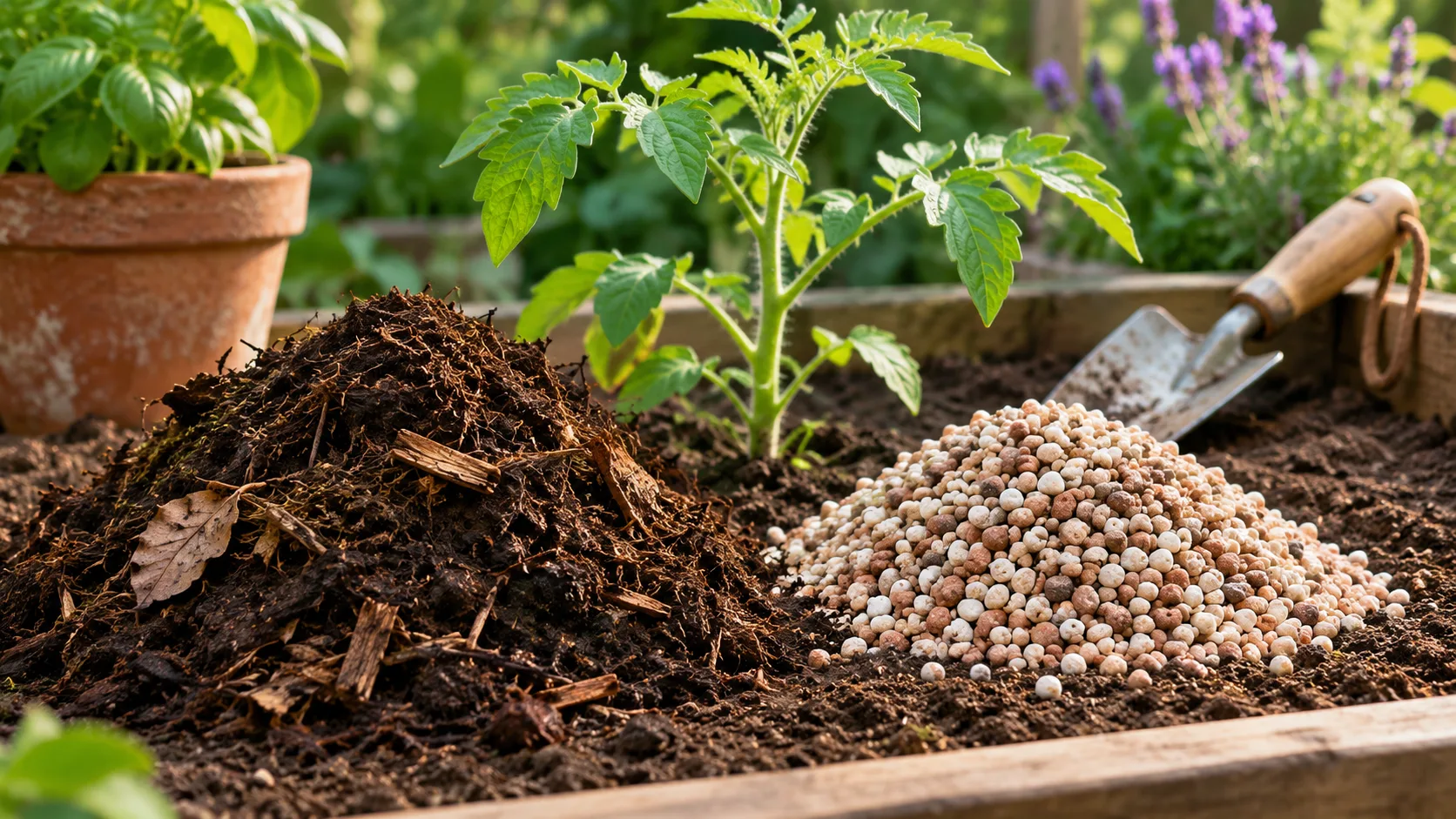
Compost and fertilizer are two of the most common products used to improve garden growth. Both can contribute nutrients to plants, but they work in different ways and are not always interchangeable. Before adding more feed to a struggling plant, check for signs of excess fertilizer.
If your garden soil is compacted, low in organic matter, or difficult to manage, compost may help improve its structure over time. If a growing plant lacks a particular essential nutrient, a suitable fertilizer may provide a more direct way to correct that shortage.
The confusion begins when gardeners assume that compost is simply a natural fertilizer or that fertilizer can replace healthy soil. Adding nutrients to poorly drained soil will not necessarily improve root growth. Likewise, spreading compost does not guarantee that rapidly growing vegetables will receive enough available nitrogen at the right time.
There is another important consideration: more is not always better. Excessive applications of compost, manure, or fertilizer can cause nutrient imbalances, damage sensitive roots, and contribute to pollution when nutrients move into waterways.
This guide explains the difference between compost and fertilizer, their benefits and limitations, how to read fertilizer labels, and when to use one or both. You will also learn how to make better feeding decisions for vegetables, flowers, lawns, houseplants, and established garden shrubs.
Quick Answer: What Is the Difference Between Compost and Fertilizer?
The main difference is that compost is primarily a soil amendment, while fertilizer is primarily a source of plant nutrients.
Compost consists of decomposed organic materials such as leaves, plant trimmings, and suitable food or garden waste. It helps improve soil structure, supports biological activity, and contributes varying amounts of nutrients as it breaks down further.
Fertilizer is a material applied mainly to supply essential plant nutrients, such as nitrogen, phosphorus, and potassium. Fertilizers may be produced from organic sources or manufactured using mineral and chemical processes.
The nutrients in compost are usually less concentrated and their availability is less predictable than those in a labeled fertilizer product.
For many gardens, the best strategy is to maintain healthy soil with appropriate organic matter and add fertilizer only when plant needs and soil nutrient levels justify it.
- Use compost when your goal is to improve soil structure, increase appropriate organic matter, or maintain healthy growing conditions.
- Use fertilizer when a plant or soil needs a particular nutrient that is not already available in sufficient amounts.
- Use both when needed if the soil benefits from organic matter and plants also require additional nutrients.
- Use neither automatically if soil tests and plant growth indicate that existing conditions are already adequate.
Gardening Tip: Think of compost as an important tool for maintaining the soil and fertilizer as a tool for meeting specific nutrient needs. Healthy soil and balanced plant nutrition work together, but adding either material unnecessarily can create problems.
What Is Compost, and How Does It Work?
Compost is organic material that has undergone controlled or managed decomposition.
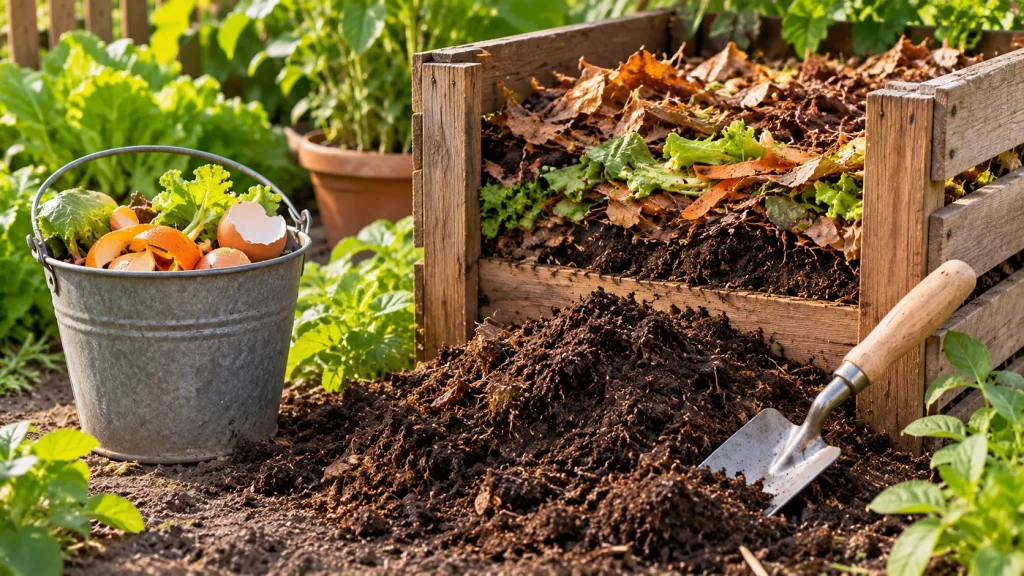
Garden compost is commonly produced from materials such as fallen leaves, vegetable scraps, suitable plant trimmings, and other biodegradable materials.
During composting, microorganisms and other decomposers break down the original material into a more stable product that can be used to improve garden soil.
What Does Finished Compost Look Like?
Good-quality finished compost is usually relatively dark, crumbly, and earthy-smelling.
Its original ingredients may no longer be easy to identify, although some coarse woody particles can remain depending on the composting process.
Compost that smells strongly of ammonia, rotten material, or sulfur may not have finished decomposing properly or may have developed unsuitable conditions during storage.
Compost quality also depends on factors that are not visible, including nutrient content, soluble salts, possible chemical residues, and potential contamination.
How Compost Improves Soil
Adding appropriate compost can improve soil aggregation and help maintain useful pore spaces.
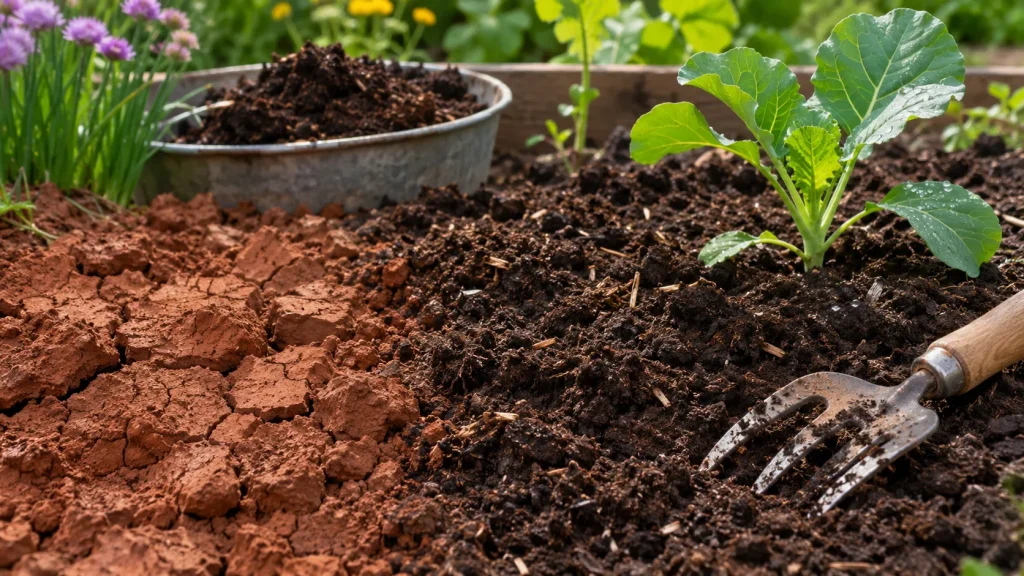
In clay-rich soil, improved aggregation may help water infiltration, aeration, and root development.
In sandy soil, compost may improve moisture and nutrient retention.
Compost also provides organic material that supports soil organisms involved in decomposition and nutrient cycling.
Does Compost Contain Plant Nutrients?
Yes. Compost can contain nitrogen, phosphorus, potassium, and other plant nutrients.
However, nutrient levels vary considerably according to the starting materials and composting process.
Compost made primarily from leaves and woody garden waste may have a different nutrient profile from composted poultry manure or nutrient-rich food waste.
Some nutrients are released gradually as organic materials continue to decompose. Others may be present in forms that are available more readily.
Consequently, compost should not automatically be treated as a precise replacement for a fertilizer with a known nutrient analysis.
Garden Compost vs. Potting Compost
In the United Kingdom and some other countries, the word compost is also used to describe commercial growing media intended for containers.
Potting compost may contain ingredients such as coir, composted bark, wood fiber, perlite, and specially formulated nutrients.
This is different from homemade garden compost used mainly as a soil amendment.
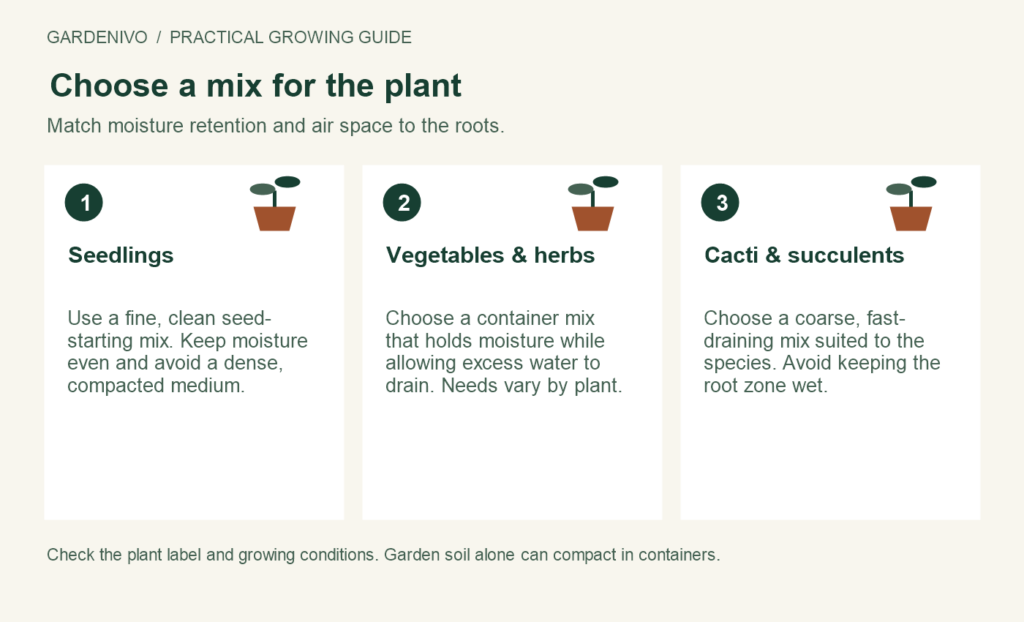
Do not assume that homemade compost alone provides the drainage, aeration, and physical structure needed for every container plant.
What Is Fertilizer, and How Does It Help Plants?
Fertilizer is a material used primarily to provide one or more essential plant nutrients.
Plants require a range of nutrients to form healthy leaves, roots, flowers, seeds, and fruit.
When soil cannot supply enough of a needed nutrient, a suitable fertilizer can help correct the shortage.
Fertilizer Can Supply Specific Nutrients
A fertilizer may supply nitrogen, phosphorus, potassium, or a combination of these and other elements.
Unlike most homemade compost, packaged fertilizers usually provide a declared nutrient analysis.
This makes it easier to calculate how much nutrient is being supplied when a soil test identifies a specific need.
Fertilizer Does Not Automatically Improve Soil Structure
Many concentrated mineral fertilizers supply nutrients without contributing significant organic matter.
They therefore do not replace the soil-conditioning benefits of compost.
Some organic fertilizers contain materials that also contribute organic matter, but their primary purpose remains supplying nutrients.
Fertilizer cannot correct major problems such as persistent waterlogging, severe compaction, insufficient sunlight, or damaged roots unless a nutrient deficiency is also involved.
Does Fertilizer Make Plants Grow Faster?
Fertilizer may improve growth when the plant is limited by insufficient available nutrients.
However, a plant that already has an adequate nutrient supply may gain little or no benefit from additional fertilizer.
Excess nutrients can cause weak growth, foliage injury, root stress, and nutrient imbalances.
Fertilizer should be used to meet plant requirements, not simply to force more growth regardless of conditions.
Compost vs. Fertilizer: Side-by-Side Comparison
The following table compares their main purposes, benefits, and limitations.
| Feature | Compost | Fertilizer |
|---|---|---|
| Main purpose | Improve soil properties and contribute nutrients | Supply particular plant nutrients |
| Primary benefit | Organic matter, structure, water management, and soil biology | Targeted plant nutrition |
| Nutrient concentration | Variable and often relatively low | Usually declared; may be much more concentrated |
| Nutrient availability | Depends on compost composition and decomposition | Depends on product formulation; can be rapid or gradual |
| Organic matter contribution | Usually substantial | Varies; often limited in mineral fertilizers |
| Effect on soil structure | Can improve aggregation and physical properties | Generally not the main purpose |
| Application guidance | Based on soil condition, compost quality, nutrients, and intended use | Based on nutrient requirements, analysis, and label rate |
| Possible problems | Excess phosphorus, salts, contamination, or unfinished material | Overfertilization, salt injury, nutrient imbalance, and runoff |
| Best used when | Soil needs suitable organic matter or conditioning | Plant nutrient needs exceed the available supply |
| Can they be used together? | Yes, when appropriate | Yes, accounting for nutrients already supplied by compost |
Soil Improvement vs. Plant Nutrition: Why the Difference Matters
Healthy plant growth depends on both a suitable physical environment and an adequate nutrient supply.
Compost is especially valuable for improving the physical and biological conditions of soil, while fertilizer is primarily concerned with nutrient availability.
Roots Need More Than Nutrients
Roots need oxygen, water, suitable temperatures, physical growing space, and available mineral nutrients.
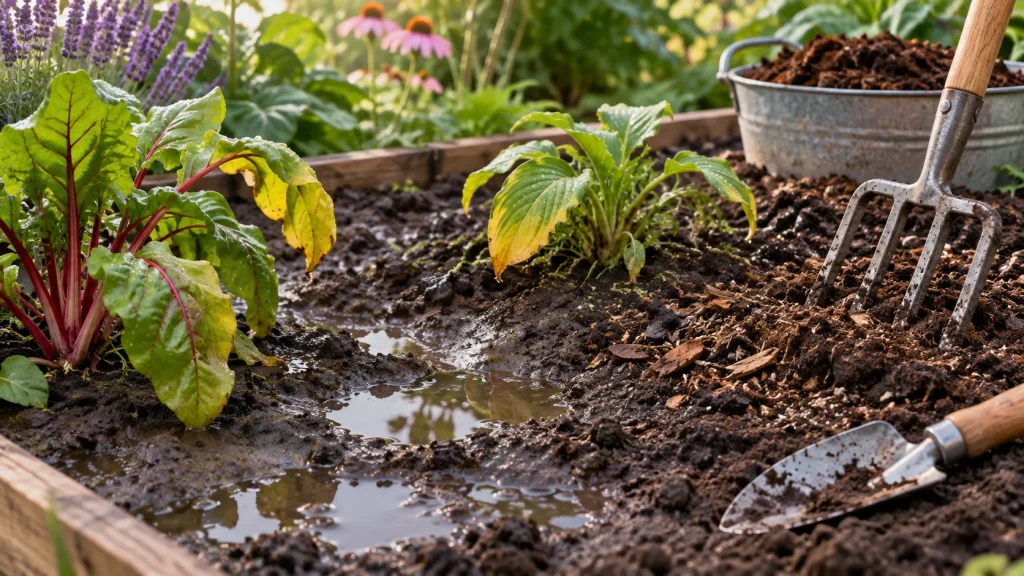
In compacted or waterlogged soil, roots may struggle even if plenty of fertilizer is present.
Adding more fertilizer cannot compensate for a lack of oxygen around the roots.
Improving drainage, preventing compaction, and maintaining suitable soil structure may be more important than feeding the plant.
Good Soil May Already Contain Enough Nutrients
Many garden soils naturally contain useful quantities of plant nutrients.
Years of compost or fertilizer applications may also have increased nutrient levels.
Applying additional fertilizer when phosphorus or potassium is already abundant provides little benefit and may create environmental problems.
A laboratory soil test is the most reliable starting point for deciding which nutrients, if any, should be added.
Organic Matter Supports Soil Processes
Appropriate compost contributes material that can support soil organisms and help maintain aggregation and pore spaces.
These improvements can help roots access existing water and nutrients more effectively.
However, soil improvement takes time and can vary with soil type, climate, compost quality, and how the garden is managed.
Understanding NPK: The Three Main Fertilizer Numbers
Fertilizer packages usually display three numbers, such as 5-5-5, 10-5-5, or 10-2-8.
These numbers describe the product’s nutrient analysis in the order nitrogen, phosphorus, and potassium.
More precisely, common fertilizer labeling expresses nitrogen as elemental N, phosphorus as phosphate equivalent (P2O5), and potassium as potash equivalent (K2O).
Nitrogen (N)
Nitrogen is important for leaf growth, chlorophyll formation, proteins, and many other plant processes.
Plants with inadequate nitrogen may become pale and grow slowly. However, yellow leaves can also result from overwatering, root damage, unsuitable pH, and several other problems.
Excess nitrogen may promote lush foliage at the expense of balanced growth and fruit production in some crops.
Phosphorus (P)
Phosphorus contributes to energy transfer, root development, and reproductive processes in plants.
However, adding extra phosphorus does not automatically produce stronger roots or more flowers.
When soil already contains sufficient phosphorus, additional applications may be unnecessary and can contribute to nutrient runoff or accumulation.
Potassium (K)
Potassium helps regulate several important plant functions, including water balance and enzyme activity.
Adequate potassium supports healthy growth and contributes to plants’ ability to function under changing environmental conditions.
Like other nutrients, it should be supplied according to plant requirements and existing soil levels.
What Does a 10-5-5 Fertilizer Label Mean?
A product labeled 10-5-5 contains, by weight:
- 10% total nitrogen (N).
- 5% available phosphate equivalent (P2O5).
- 5% soluble potash equivalent (K2O).
The remaining weight consists of other ingredients and materials included in the product.
A higher number does not automatically indicate a better fertilizer. The correct product depends on the nutrients the plant needs and the amount already available in the soil.
What About Other Essential Nutrients?
Plants also need calcium, magnesium, sulfur, iron, manganese, zinc, boron, copper, molybdenum, chlorine, nickel, and other essential elements.
Micronutrients are required in smaller amounts, but they remain essential for normal growth.
Deficiencies should be identified before applying concentrated micronutrient products, because the margin between adequate and excessive amounts may be small for some elements.
Organic vs. Synthetic Fertilizers: Are They Different?
Fertilizers can be produced from a wide range of sources, including plant materials, animal byproducts, mined minerals, and industrial processes.
Both organic and synthetic fertilizers can supply nutrients that plants need.
Organic Fertilizers
Organic fertilizers are commonly derived from plant or animal materials, such as certain seed meals, feather meal, bone meal, and processed manure products.
Many release nutrients through biological decomposition, although the rate depends on the material and environmental conditions.
Some organic fertilizer products may also contribute organic matter.
However, the term organic does not automatically mean that a product is harmless, perfectly balanced, or suitable for every plant.
Excessive use can still lead to nutrient imbalances, elevated salts, or environmental losses.
Synthetic or Manufactured Fertilizers
Manufactured fertilizers commonly provide nutrients in specified concentrations and chemical forms.
Some are highly water-soluble and supply nutrients relatively quickly. Others are specially formulated to release nutrients over a longer period.
These products can be useful when a known deficiency requires a measured nutrient application.
However, concentrated fertilizer can injure roots or foliage when applied at excessive rates or under unsuitable conditions.
Do Plants Prefer Organic or Synthetic Nutrients?
Plants absorb essential nutrients in specific chemical forms, regardless of whether the original nutrient source was organic or synthetic.
For example, plants commonly absorb nitrogen as nitrate or ammonium ions.
Many organic nitrogen sources must first be broken down by soil microorganisms before substantial amounts become available to roots.
Both fertilizer categories can support healthy plants when used correctly.
Environmental impact depends on factors such as production, transport, nutrient release, application rate, and the risk of nutrients moving into waterways.
Quick-Release vs. Slow-Release Fertilizers
A quick-release fertilizer supplies nutrients that can become available relatively rapidly under suitable conditions.
A slow-release or controlled-release fertilizer distributes nutrient availability over a longer period.
Both organic and manufactured products can have slow-release characteristics.
The correct choice depends on the crop, growing medium, temperature, watering, and nutrient needs.
Always follow the product’s recommended application rate and schedule rather than assuming that every slow-release product works for the same number of months.
Benefits and Limitations of Using Compost in a Garden
Compost can be one of the most useful soil-improving materials available to home gardeners, especially when applied in suitable amounts.
1. Improves Soil Structure
Suitable compost contributes organic matter that can help improve soil aggregation and create a more favorable balance of air and water.
This is valuable in both heavy clay and fast-draining sandy soils, although the effects are not identical.
2. Helps Soil Manage Moisture
Compost can improve the capacity of many soils to store useful moisture while also helping water move through appropriately structured soil.
The actual result depends on soil type, compost properties, and existing drainage conditions.
Adding compost will not necessarily fix a high water table, blocked drainage, or severe site-wide waterlogging.
3. Supports Soil Organisms
Compost provides organic material used by soil microorganisms and other decomposers.
Biological activity contributes to nutrient cycling and can help develop more stable soil structure.
4. Contributes Nutrients Gradually
Compost supplies varying amounts of plant nutrients. Some are available relatively soon, while others become available as organic material decomposes further.
This can reduce the need for additional fertilizer in some established garden soils.
However, the contribution depends on compost analysis, application history, and plant requirements.
5. Recycles Suitable Garden Waste
Home composting can turn suitable leaves, plant trimmings, and food scraps into a useful soil amendment.
This can reduce the need to dispose of certain organic materials and help return some of their nutrients and organic matter to the garden.
Limitations of Compost
Compost has limitations that gardeners should consider:
- Its nutrient concentration and release rate may be difficult to predict without testing.
- Some composts contain substantial phosphorus, potassium, or soluble salts.
- Unfinished compost may temporarily affect nutrient availability or create unsuitable growing conditions.
- Contaminated material may introduce weed seeds, plant pathogens, or persistent herbicide residues.
- Excessive application can create nutrient imbalances and environmental problems.
Compost should be selected and applied with as much care as any other garden amendment.
Benefits and Limitations of Using Fertilizer
Fertilizer is especially useful when the soil’s existing nutrient supply cannot meet plant demand.
1. Can Supply a Specific Missing Nutrient
If a soil test identifies insufficient potassium, a suitable fertilizer can supply potassium without necessarily adding large amounts of other nutrients.
Likewise, a nitrogen-focused fertilizer may be appropriate when plants need nitrogen but soil phosphorus levels are already high.
This targeted approach is often more useful than applying a general fertilizer containing nutrients that are not needed.
2. Can Support Nutrient-Demanding Crops
Actively growing vegetables and certain other crops can have substantial nutrient requirements.
If soil and compost cannot supply sufficient nutrients during the growing season, appropriate fertilizer may support healthy growth and production.
3. Allows More Measured Nutrient Applications
Commercial fertilizers usually include a guaranteed nutrient analysis and directions for application.
These labels make it possible to select products that better match soil test recommendations.
Using a measured product is particularly helpful when the garden needs one nutrient but already contains sufficient quantities of others.
Limitations of Fertilizer
Fertilizer also has disadvantages when used unnecessarily or incorrectly.
- Excess fertilizer may cause salt injury or damage sensitive roots.
- Too much nitrogen can encourage excessive foliage growth.
- Unneeded nutrients may accumulate in soil.
- Rainfall or irrigation can move nutrients into waterways.
- Mineral fertilizers do not normally contribute the same soil-conditioning benefits as compost.
- Feeding cannot correct unrelated plant problems such as root rot or severe shade.
The best fertilizer is not necessarily the strongest or most expensive product. It is the one that supplies the nutrients actually needed at an appropriate rate.
When Should You Use Compost Instead of Fertilizer?
The decision begins with identifying what the soil or plant actually needs.
Use Compost When Soil Structure Is Poor
If your soil becomes hard, compacted, or difficult to manage, suitable compost may help improve its physical structure over time.
For clay soil, this may improve aggregation. For sandy soil, compost can help improve water and nutrient retention.
Preventing compaction, mulching, and maintaining healthy plant roots are also important parts of long-term soil management.
Use Fertilizer When a Nutrient Shortage Is Identified
If a soil test recommends a particular nutrient and the plant is likely to benefit, select an appropriate fertilizer.
A targeted application may be more effective than adding large quantities of compost in an attempt to correct a single deficiency.
This is especially important when the soil already has high phosphorus or potassium levels.
Use Neither Automatically When Plants Are Healthy
Many established shrubs, trees, and perennials grow well in suitable soil without regular fertilizer applications.
If soil organic matter and nutrient levels are already appropriate, additional compost may also be unnecessary.
Use soil tests, growth observations, and species-specific recommendations to avoid unnecessary work and expense.
Do Not Use Fertilizer to Treat Every Yellow Leaf
Yellow leaves can indicate nutrient limitations, but they can also result from overwatering, poor drainage, natural aging, insufficient light, and other plant-health problems.
Check the soil moisture, roots, growing conditions, and pattern of symptoms before applying fertilizer.
Correcting the underlying cause is more important than adding nutrients that may not be needed.
Can You Use Compost and Fertilizer Together?
Yes. Compost and fertilizer can complement each other when they are selected and applied according to actual soil and plant needs.
Compost can improve the growing environment and contribute nutrients. Fertilizer can then supply a specific nutrient that remains insufficient.
Example: A Vegetable Bed With Low Organic Matter
Imagine a vegetable bed with low organic matter and a soil test indicating that additional nitrogen is needed, but phosphorus and potassium are already sufficient.
A modest quantity of suitable plant-based compost may help improve soil properties.
A nitrogen-focused fertilizer can then be selected according to the crop and soil test recommendations rather than applying a complete fertilizer containing additional phosphorus and potassium.
This approach can address both the soil condition and nutrient need without supplying unnecessary nutrients.
Example: A Garden Already Rich in Nutrients
Consider a well-established garden that has received composted manure for several years.
A soil test may reveal high phosphorus and potassium levels.
Even though compost is generally considered beneficial, adding another thick layer of manure-based compost could contribute to nutrient accumulation.
In this situation, reducing compost additions and using cover crops or appropriate mulch may be more sensible than continuing the same feeding routine.
Account for Nutrients Already in Compost
Compost is not nutritionally empty.
If you apply nutrient-rich compost and then add full rates of multiple fertilizers, the combined nutrient supply may exceed plant requirements.
Review compost analysis where available and consider the garden’s history of nutrient applications.
Regular soil testing can help identify whether nutrients are accumulating over time.
Important Caution: Using compost and fertilizer together is not automatically better. Both contribute nutrients, and excessive amounts can cause root injury, high soil phosphorus, or pollution. Always account for existing soil fertility, compost composition, and the nutrients supplied by other products.
How to Apply Compost and Fertilizer Correctly
Compost and fertilizer should be handled according to their intended purposes. The appropriate application method depends on the soil, crop, season, and product.
How to Apply Compost to Garden Soil
For an ordinary established garden, use the following approach:
- Assess soil needs. Check organic matter and nutrient levels through suitable testing where practical.
- Choose mature compost. Use well-finished, appropriate material from a reliable source.
- Check the material. Avoid compost with strong unpleasant odors, obvious contamination, or unsuitable salt levels.
- Remove troublesome weeds. Prepare the growing area without unnecessarily disturbing established roots.
- Apply an appropriate amount. Use the quantity recommended for the soil and planting rather than a universal thick layer.
- Incorporate only when useful. New beds may benefit from appropriate shallow mixing; established beds may be better suited to surface applications.
- Keep plant crowns clear. Do not bury young seedlings, tender stems, or the root flare of woody plants.
- Monitor soil and plant growth. Check whether further amendments are needed before repeating the application.
How Much Compost Should You Add?
There is no single correct amount for every soil and garden.
University of Minnesota Extension suggests that approximately 1.25 cm (half an inch) of suitable non-manure-based compost across the surface may be enough for many vegetable and flower gardens when the purpose is soil building.
This is a useful reference point, not a universal annual requirement. Different soils and initial preparation projects may justify other rates.
Composted manure should generally be considered a nutrient source as well as an amendment because its phosphorus and other nutrient levels may be substantial.
Soil testing and compost quality should guide the amount applied.
How to Apply Fertilizer Safely
- Identify the nutrient requirement. Use soil tests, plant needs, and suitable local gardening guidance.
- Read the NPK label. Choose a formulation that supplies the nutrients needed without unnecessarily increasing nutrients already present.
- Calculate the application rate. Follow the product’s directions and use accurate measuring equipment.
- Apply at the appropriate growth stage. Timing depends on the plant, product, and growing conditions.
- Keep fertilizer away from sensitive tissues when required. Avoid piling concentrated fertilizer directly against stems or roots.
- Follow watering instructions. Some products need watering into the soil, while others are applied differently.
- Prevent runoff and spills. Do not leave fertilizer on pavements where rain can wash it into drains.
- Record the application. Note the date, product, rate, and plants treated to avoid accidental repeated feeding.
When Is the Best Time to Fertilize?
Fertilizer timing depends on the plant’s active growth, nutrient demand, and the product’s nutrient-release characteristics.
Some vegetables need additional nutrients during establishment and periods of strong growth or fruit production.
Other plants may need little or no supplementary feeding when grown in adequate soil.
Avoid automatically applying fertilizer during dormancy or severe environmental stress unless a specific recommendation supports it.
Food Safety When Using Manure-Based Compost
Composted animal manure differs from ordinary plant-based compost because it may contain relatively high nutrient concentrations and requires appropriate treatment to reduce food-safety risks.
Choose properly processed manure compost from a reliable source when applying it to edible gardens.
Raw or inadequately composted manure can contain organisms capable of causing foodborne illness, and its use requires special precautions and appropriate intervals before harvesting edible crops.
University extension guidance commonly describes waiting periods of at least 120 days before harvesting crops whose edible parts contact the soil and 90 days for other edible crops after raw manure incorporation, in accordance with relevant organic production guidance. Requirements can vary by jurisdiction and situation.
For ordinary home vegetable gardens, properly composted materials are generally a more practical choice than applying untreated manure near crops intended for human consumption.
Never use dog, cat, or human waste as an ordinary vegetable garden amendment.
Compost or Fertilizer: What Do Different Garden Plants Need?
Different plants and growing systems have different nutrient demands. The best amendment depends on the plant, soil test results, and how the growing area is managed.
| Growing situation | Compost considerations | Fertilizer considerations |
|---|---|---|
| Vegetable garden beds | Useful for maintaining suitable organic matter and soil structure | May be needed for nutrient-demanding crops, based on soil tests and crop needs |
| Tomatoes and peppers | Can improve the growing environment and contribute nutrients | Targeted feeding may be appropriate, avoiding excessive nitrogen |
| Leafy vegetables | Supports soil health when suitable | Adequate available nitrogen is important for active leaf growth |
| Established ornamental shrubs | Surface applications may support soil health when needed | Many healthy shrubs need little or no routine fertilizer |
| Flower beds | Can help maintain soil structure and moisture balance | Apply only when plant requirements justify additional nutrients |
| Lawns | Suitable compost top-dressing may improve soil properties | Species-specific fertilizer may be needed according to soil tests and turf requirements |
| Container vegetables | May be one component of a suitable potting mix | May be needed because frequent watering and crop growth use available nutrients |
| Common houseplants | Homemade garden compost alone is usually not an ideal potting medium | Use appropriate feeding only when needed during suitable growth periods |
Vegetable Gardens
Vegetable gardens may benefit from suitable compost because crops are grown and harvested repeatedly, often with significant soil disturbance.
Maintaining soil organic matter and good structure can support root growth and water availability.
However, different vegetables have different nutrient demands. Leafy vegetables, fruiting crops, and legumes should not automatically receive identical fertilizer applications.
Use crop-specific recommendations and soil tests to determine whether supplementary nutrients are needed.
Tomatoes and Peppers
Tomatoes and peppers require suitable soil conditions and adequate nutrient availability for healthy growth and production.
Compost can contribute to better soil properties, but nutrient-demanding crops may still need suitable fertilizer when soil supplies are insufficient.
Excessive nitrogen can encourage vigorous leafy growth without necessarily improving fruit production.
Do not assume that a fertilizer advertised as a flowering or tomato booster is necessary when soil phosphorus and potassium are already sufficient.
Established Shrubs and Perennials
Many established ornamental plants grow successfully without annual fertilizer applications.
Appropriate mulch and healthy soil management may provide greater benefit than routine feeding.
Where a specific nutrient deficiency is identified, fertilizer may be appropriate, but use a species-specific recommendation.
Lawns
Suitable compost top-dressing can contribute organic matter and support soil properties in certain lawns.
However, compost’s nutrient content may not match the specific requirements of actively growing turfgrass.
Lawn fertilizer decisions should consider the turfgrass species, soil fertility, climate, and timing of active growth.
Overfertilization can increase maintenance demands and contribute to environmental nutrient losses.
Container Plants
Container plants grow in a limited volume of potting medium.
Some commercial mixes contain starter fertilizer, but the nutrient supply may decline as plants grow and nutrients are used or washed from the container.
Appropriate supplemental feeding may be needed for long-season vegetables and some actively growing container plants.
However, adding concentrated fertilizer without checking existing nutrients can cause salt accumulation and root damage.
Use a suitable potting mix rather than filling ordinary containers with pure homemade compost.
10 Common Compost and Fertilizer Mistakes to Avoid
1. Assuming Compost and Fertilizer Are the Same Thing
Compost mainly improves soil properties and contributes variable nutrients, while fertilizer is used to supply particular nutrients.
Better approach: Decide whether the main problem involves soil condition, nutrient supply, or both.
2. Applying Fertilizer Without Checking Plant Needs
Healthy plants may not require extra feeding, and additional nutrients will not solve every growth problem.
Better approach: Use soil testing, plant identification, and suitable guidance before applying fertilizer.
3. Adding Excessive Compost Every Year
Repeated thick applications can lead to nutrient accumulation, especially when compost is made from manure or other nutrient-rich materials.
Better approach: Monitor soil fertility and apply only the amount justified by soil condition and plant needs.
4. Thinking Organic Products Cannot Burn Plants
Organic fertilizers and nutrient-rich composts can still cause salt problems or other damage when used excessively.
Better approach: Follow product guidance and consider nutrient concentrations, not just whether the material is labeled organic.
5. Choosing Fertilizer Only by Its Highest NPK Number
A highly concentrated fertilizer is not automatically better for a garden.
Better approach: Select a nutrient ratio that matches actual soil and plant requirements, then apply the correct rate.
6. Using Unfinished Compost Around Sensitive Plants
Insufficiently decomposed material can have unstable nutrient behavior and may produce unfavorable root conditions.
Better approach: Use mature, suitable compost from a reliable source, especially near seedlings and edible crops.
7. Using Raw Manure Without Food-Safety Precautions
Untreated manure can contain human pathogens and may cause contamination risks in edible gardens.
Better approach: Prefer properly composted material and follow relevant food-safety guidance if raw manure is used.
8. Using Fertilizer to Treat Drainage or Root Problems
Poor drainage, compaction, or root disease can prevent plants from growing normally even when adequate nutrients are present.
Better approach: Diagnose the growing conditions before applying additional nutrients.
9. Ignoring Nutrient Runoff and Environmental Effects
Excess nutrients can move from gardens into nearby water systems through runoff, erosion, or leaching.
Better approach: Avoid unnecessary applications, prevent fertilizer spills, and keep soil appropriately covered.
10. Following the Same Feeding Schedule for Every Plant
Vegetables, trees, lawns, houseplants, and flowering shrubs have different nutrient requirements and growing cycles.
Better approach: Use crop-specific guidance and adjust feeding to soil conditions, active growth, and product recommendations.
Frequently Asked Questions About Compost and Fertilizer
Is compost the same as fertilizer?
No. Compost is primarily a soil amendment that contributes organic matter and varying amounts of nutrients. Fertilizer is primarily used to provide specific plant nutrients. Compost can reduce the need for fertilizer, but the two materials have different main purposes.
Can compost replace fertilizer completely?
Sometimes, if the compost and existing soil together supply enough nutrients for the plants. However, nutrient-demanding crops may still need supplemental feeding. Compost composition, application history, soil testing, and plant requirements determine whether additional fertilizer is necessary.
Is compost better than chemical fertilizer?
Neither is universally better. Compost is particularly useful for improving soil organic matter and structure. A suitable fertilizer can provide a more precise supply of nutrients when a deficiency exists. Many gardens benefit from appropriate soil management combined with targeted feeding when needed.
Can I add compost and fertilizer at the same time?
Yes, when both are needed and their combined nutrient contribution is appropriate. Avoid applying full amounts of several nutrient-rich materials without considering soil fertility, compost composition, and product instructions.
Does compost contain nitrogen, phosphorus, and potassium?
Yes. Compost generally contains all three, but the concentrations vary widely. Some materials have relatively low nutrient levels, while composted manure can be substantially richer. A laboratory analysis is the most reliable way to determine the nutrient content of a specific compost.
How much compost should I add to my garden?
The correct amount depends on the soil, compost type, nutrient levels, and planting purpose. A modest surface application may be enough for many established beds, while certain new-bed projects need a different approach. Use soil testing and locally appropriate guidance rather than applying a thick layer automatically every year.
Can too much compost harm plants?
Yes. Excessive compost can cause high nutrient concentrations, soluble salt problems, and imbalances. Repeated use of manure-based compost is particularly important to monitor because phosphorus may accumulate over time.
What do the numbers on fertilizer packaging mean?
The three numbers describe nitrogen (N), available phosphate equivalent (P2O5), and soluble potash equivalent (K2O), expressed as percentages by weight. For example, 10-5-5 indicates 10% nitrogen, 5% phosphate equivalent, and 5% potash equivalent.
Do all plants need fertilizer every month?
No. Fertilizer needs vary by species, nutrient availability, growing medium, and season. Some actively growing container plants need relatively regular feeding, while many established garden shrubs require little or no additional fertilizer.
Can fertilizer improve clay soil?
Fertilizer can correct certain nutrient deficiencies, but it does not usually improve the physical structure of clay soil. Suitable compost, organic mulch, prevention of compaction, and appropriate drainage management are more relevant when the main problem is poor soil structure.
Should I fertilize plants when their leaves turn yellow?
Not automatically. Yellow leaves may be caused by insufficient nutrients, but overwatering, drainage problems, root damage, low light, and natural leaf aging are also common possibilities. Diagnose the problem before applying fertilizer.
What is the best choice for a beginner: compost or fertilizer?
Start by understanding the growing conditions. If the garden needs suitable organic matter, good-quality finished compost may be helpful. If a soil test identifies a nutrient shortage, a fertilizer matched to that requirement may be appropriate. Many beginners can avoid unnecessary spending by testing soil and observing their plants before buying amendments.
Final Thoughts
Compost and fertilizer both have valuable roles in gardening, but their purposes are different.
Compost mainly improves soil properties, contributes organic matter, and supplies variable amounts of nutrients. Fertilizer is designed primarily to supply specific nutrients in quantities that can be selected according to plant needs.
Healthy soil and balanced nutrition are connected. A plant growing in compacted, waterlogged soil may struggle even when fertilizer is abundant. Likewise, compost alone may not provide enough available nutrients for certain crops during periods of strong growth.
The best approach is to assess soil conditions, test nutrient levels when appropriate, and choose amendments deliberately. Avoid adding large quantities of compost every year or applying fertilizer simply because plant growth appears slower than expected.
When used in suitable amounts, compost and fertilizer can complement each other. But sometimes the most effective gardening decision is to add neither and concentrate on watering, drainage, light, or other growing conditions instead.
For more guidance on maintaining healthy growing conditions, explore Gardenivo’s Soil & Watering articles. You can also visit Vegetable Gardening for crop-specific growing advice and Lawn & Garden Care for outdoor maintenance guidance.
Further Reading and Horticultural References
- Royal Horticultural Society: Composting — making garden compost, recognizing finished material, and using compost as a soil improver or mulch.
- Royal Horticultural Society: Organic Matter — How to Use It in the Garden — improving soil structure and fertility through suitable organic materials.
- Royal Horticultural Society: Fertilisers — Types and Uses — organic and inorganic fertilizer types, nutrient release, and application methods.
- University of Maryland Extension: Garden Fertilizer Basics — NPK labels, soil testing, fertilizer selection, and avoiding overapplication.
- University of Maryland Extension: Fertilizing Vegetable Gardens — nutrient requirements and appropriate fertilizer practices for edible crops.
- University of Maryland Extension: What Compost Should I Use? — choosing compost for organic matter or nutrient contributions.
- University of Minnesota Extension: Soil Testing for Lawns and Gardens — deciding when to use compost or fertilizer based on soil nutrients and organic matter.
- Oregon State University Extension: How to Use Compost in Gardens and Landscapes — soil amendment benefits, application rates, and problems caused by excessive compost.
- Oregon State University Extension: A Guide to Understanding Fertilizers — nutrient analysis, organic fertilizers, and plant feeding.
- Oregon State University Extension: Interpreting Compost Analyses — compost nutrients, soluble salts, carbon-to-nitrogen ratios, and quality.
- University of Minnesota Extension: How to Correct Problems Caused by Too Much Compost and Manure — nutrient accumulation, excessive salts, and better long-term practices.