Mulching a Garden: Benefits and Common Mistakes
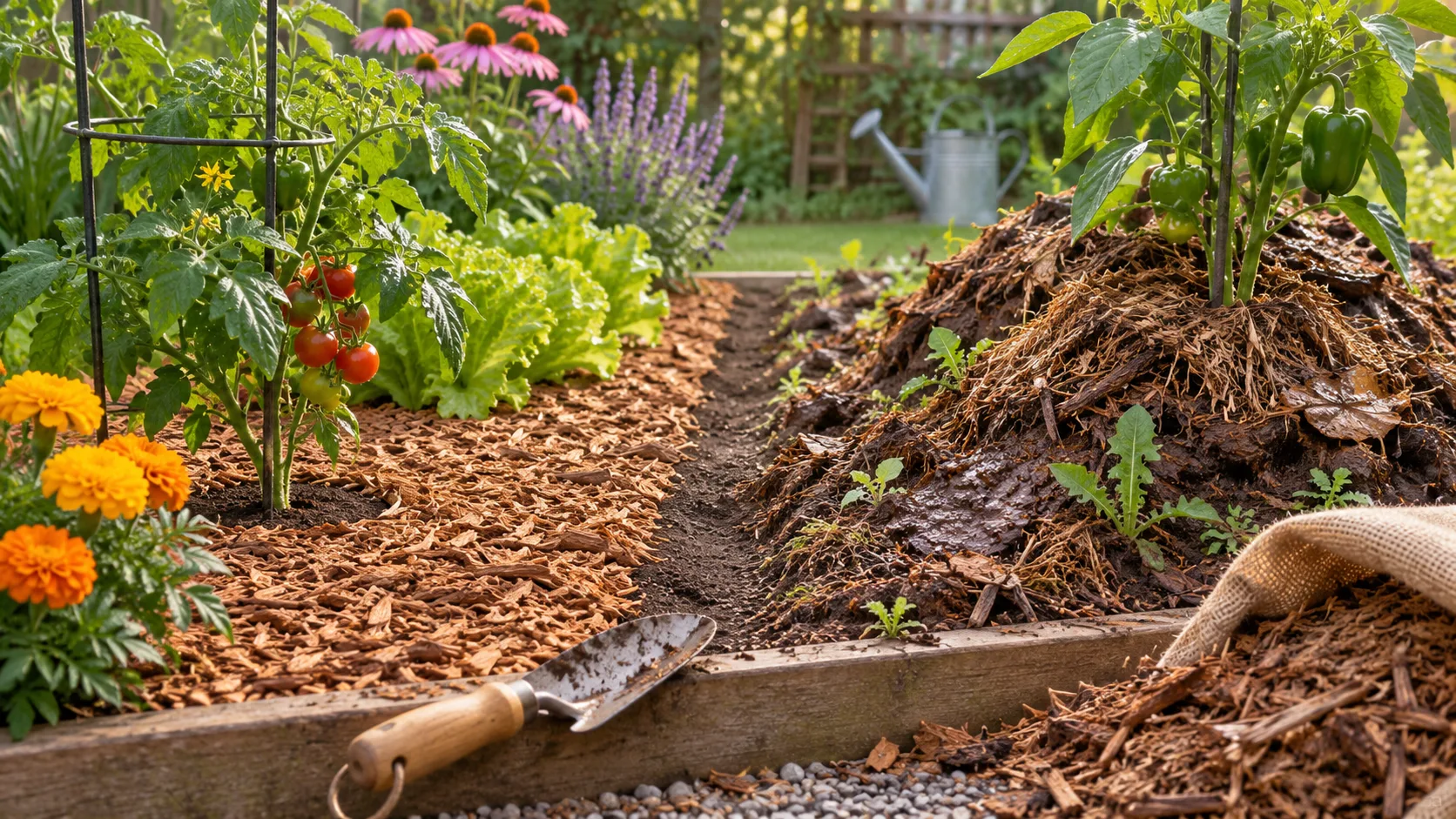
Mulching is one of the simplest ways to improve garden soil and reduce routine maintenance. A suitable layer of mulch can help retain moisture, suppress weeds, protect roots from temperature extremes, and keep planting beds looking tidy. Before watering a mulched bed, check moisture in the soil underneath.
However, mulch is not automatically beneficial in every situation. Applying it too deeply, piling it around tree trunks, using contaminated materials, or choosing the wrong type of mulch can create problems for plants.
A vegetable garden may benefit from clean straw or shredded leaves, while established trees and shrubs often perform well with wood chips or bark. Containers, seedlings, and winter-sensitive perennials may need different materials and application methods.
This guide explains the benefits of mulching a garden, how to choose appropriate materials, when and how to apply them, and which common mistakes to avoid. You’ll also learn how to maintain mulch throughout the year without interfering with watering, drainage, or healthy plant growth.
Quick Answer: What Is the Correct Way to Mulch a Garden?
For many established garden beds, apply an approximately 5–8 cm (2–3 inch) layer of suitable organic mulch over the soil surface after removing troublesome weeds and checking that the ground is appropriately moist.
Spread mulch evenly rather than piling it into thick mounds. Leave a clear space around tree trunks, woody stems, sensitive plant crowns, and young seedlings to avoid trapping excessive moisture against them.
Choose material according to the planting area. Wood chips or shredded bark are often useful around established trees and shrubs. Clean straw, shredded leaves, or other suitable organic materials can work well in vegetable gardens.
Check the soil beneath the mulch when watering. A mulched surface may look dry while the root zone remains moist, or the mulch itself may become wet without enough water reaching the roots.
Replenish organic mulch only when it has decomposed or thinned enough to need more. Avoid adding another full layer every year without checking the existing depth.
Gardening Tip: Keep the plant’s stem and crown visible after mulching. A broad, even layer over the surrounding soil is usually more useful than a thick pile directly around the plant.
What Is Mulch and How Does It Work?
Mulch is a layer of material placed over the surface of soil or growing medium. It may consist of organic materials such as wood chips, bark, straw, leaves, or compost, or inorganic materials such as gravel and certain landscape coverings.
The main purpose is to create a protective covering between the exposed soil and the surrounding environment.
When applied appropriately, mulch reduces direct exposure to sunlight, wind, and heavy rain. Depending on the material, it can also make it harder for some weed seeds to receive the light required for germination.
Organic mulch gradually breaks down through the activity of soil organisms. As it decomposes, it contributes organic material to the soil and may influence soil structure and nutrient availability.
Inorganic materials provide physical coverage but do not contribute meaningful organic matter as they remain in place.
Mulch Is Different From a Soil Amendment
Mulch is usually placed on top of the soil, while a soil amendment may be incorporated into the soil to improve particular physical or chemical properties.
The same organic material can sometimes serve either purpose. For example, suitable finished compost may be applied as a surface dressing or incorporated into a planting bed where appropriate.
However, coarse wood chips are generally more useful as surface mulch around established woody plants than as material mixed directly into vegetable-growing soil.
Does Mulch Replace Watering?
No. Mulch can reduce evaporation from the soil surface, but plants still use water through their roots and lose moisture through transpiration.
Vegetables, young transplants, and container plants may continue to need regular moisture monitoring, particularly during hot or windy weather.
Mulch is a tool for conserving available moisture, not a substitute for a suitable water supply.
7 Important Benefits of Mulching a Garden
1. Helps Soil Retain Moisture
One of the most useful benefits of mulch is reducing evaporation from the soil surface.
Exposed soil can lose moisture quickly in hot, dry, or windy weather. A suitable mulch layer limits direct exposure and helps maintain more consistent conditions around plant roots.
The amount of water conserved depends on the mulch material, soil type, weather, and application depth.
Mulch can reduce watering demands, but it does not mean that every plant will require the same irrigation schedule.
2. Suppresses Many Common Weeds
Mulch can make it more difficult for some weed seeds to germinate and establish by reducing light at the soil surface.
This is especially useful in flower borders, vegetable beds, and landscape areas where bare soil would otherwise be exposed.
However, mulch does not eliminate every weed. Established perennial weeds may grow through it, and windblown seeds can germinate in organic material that accumulates on top.
Removing existing troublesome weeds before mulching generally improves the result.
3. Moderates Soil Temperature
Mulch acts as an insulating layer that reduces rapid temperature changes near the soil surface.
During summer, suitable organic mulch can reduce soil exposure to intense sunlight and help protect roots from extreme heat.
During winter, mulching can help moderate temperature fluctuations and reduce repeated freezing and thawing around certain perennial plants.
The effect depends on mulch color, thickness, material, and climate. Dark stone or plastic coverings may have a warming effect rather than cooling the soil.
4. Protects Soil From Erosion
Heavy rainfall can displace soil particles, cause surface crusting, and contribute to erosion.
A suitable mulch layer reduces the direct impact of raindrops on bare soil and may slow surface runoff.
This can be valuable on exposed beds and gentle slopes, although steep sites or areas with substantial water flow may require additional erosion-control measures.
5. Adds Organic Matter as It Decomposes
Organic materials such as shredded leaves, compost, bark, and wood chips gradually break down.
As decomposition occurs, organic matter enters the soil through the activity of fungi, bacteria, earthworms, and other organisms.
Over time, this can help improve soil structure and support biological activity.
However, mulch is not automatically a complete fertilizer. Nutrient contributions vary by material, and plant feeding decisions may still require soil testing or crop-specific recommendations.
6. Protects Trees and Shrubs From Maintenance Damage
A suitable mulched area around a tree or shrub can reduce competition from lawn grass and create separation from mowing equipment.
This helps reduce the risk of accidental damage to bark from lawnmowers and string trimmers.
The mulch should cover a useful area of the root zone without being piled against the trunk or covering the root flare.
7. Can Reduce Routine Garden Maintenance
By limiting some weed growth, slowing soil moisture loss, and protecting exposed soil, mulch can reduce the time spent weeding and watering.
It can also create a more consistent appearance in flower beds and landscaped areas.
Good mulching does not remove the need for regular garden inspection, but it can help make common maintenance tasks more manageable.
Organic vs. Inorganic Mulch: What Is the Difference?
Garden mulches fall into two broad categories: organic materials that biodegrade and inorganic materials that generally remain in place for longer.
Organic Mulch
Organic mulch includes materials derived from plants and other biodegradable sources.
Examples include wood chips, shredded bark, clean straw, shredded leaves, pine needles, suitable grass clippings, and finished compost.
These materials offer various combinations of moisture retention, weed suppression, temperature moderation, and organic matter contribution.
Because organic mulch decomposes, it eventually needs replenishment. The rate varies according to material, particle size, moisture, and climate.
Inorganic Mulch
Inorganic mulches include gravel, stone, and certain synthetic landscape coverings.
Some provide long-lasting coverage and may be suitable for particular rock gardens, dry-climate plantings, or landscape designs.
However, stones do not improve soil organic matter, and exposed rock surfaces can become very hot in strong sunlight.
Landscape fabrics and plastic sheets also require careful consideration. Some block water or restrict future soil management, while weeds can eventually grow in material that accumulates over them.
For many ordinary vegetable and ornamental beds, biodegradable mulch offers a useful combination of soil protection and long-term soil improvement.
How to Choose the Best Mulch for Your Garden
The best mulch depends on what you are growing, how frequently the area needs cultivation, and whether your priority is weed control, soil improvement, moisture conservation, or appearance.
| Mulch material | Common uses | What to consider |
|---|---|---|
| Wood chips | Established trees, shrubs, and perennial borders | Long-lasting; avoid deep piles and mixing large amounts into growing soil |
| Shredded bark | Landscape borders and established woody plants | Decorative and slow to decompose; keep away from trunks |
| Clean straw | Vegetable beds and strawberries | Lightweight; choose material with minimal weed seeds |
| Shredded leaves | Vegetable gardens, flower beds, and perennial borders | Recycle garden leaves; thick whole-leaf layers may mat together |
| Finished compost | Garden beds needing suitable surface organic matter | Decomposes relatively quickly; nutrient content varies |
| Dry grass clippings | Vegetable and flower beds in thin layers | Avoid thick mats, seeded grass, and herbicide-contaminated material |
| Pine needles | Suitable shrubs, woodland-style beds, and established plantings | Allow water through and provide coverage; monitor depth |
| Gravel or stone | Specialized dry plantings, rock gardens, and paths | Does not add organic matter and may increase soil heat |
Wood Chips and Shredded Bark
Wood chips and bark are frequently used around established trees, shrubs, and ornamental borders because they tend to break down relatively slowly.
They help maintain soil coverage without needing replacement as often as some finer materials.
Fresh arborist wood chips can be suitable as surface mulch in established woody plantings, although advice varies according to the material and plant type.
Avoid incorporating large amounts of fresh woody material into the soil around young plants. Microbial decomposition can temporarily compete for available nitrogen, particularly where fine, high-carbon particles are mixed into the root zone.
Straw and Shredded Leaves
Clean straw is commonly used in vegetable beds and around strawberries. It provides surface coverage, reduces soil splash, and can help keep produce from resting directly on bare soil.
Straw should be reasonably free from weed seeds and unwanted plant material.
Shredded autumn leaves are another useful choice. They recycle organic material from the garden and can gradually contribute to soil improvement.
Shredding leaves helps prevent large layers of whole leaves from compacting into mats that interfere with water movement or smother small plants.
Compost as Mulch
Suitable finished compost can be spread over the soil surface to contribute organic matter and nutrients.
Because compost is usually finer and more nutrient-rich than wood chips or straw, a thinner application is often appropriate. Around 2.5 cm (1 inch) may be a useful general approach, adjusted according to soil conditions and compost properties.
Compost may not suppress weeds as effectively as a coarser, persistent covering, especially if the layer breaks down quickly.
Use well-prepared compost and consider soil nutrient levels before applying substantial quantities repeatedly.
Grass Clippings
Grass clippings can be useful as a recycled garden mulch when applied correctly.
Allow clippings to dry and spread them in relatively thin layers, commonly no more than about 2.5–5 cm (1–2 inches) at a time.
Thick piles of fresh, wet clippings may mat together, restrict airflow and moisture movement, and produce unpleasant odors as they decompose.
Do not use grass clippings from lawns recently treated with herbicides unless the product label specifically allows that use. Residues from some herbicides can damage vegetables, flowers, and other sensitive plants.
Good to Know: Wood chips placed on the soil surface are not the same as wood chips mixed into the soil. Concerns about temporary nitrogen competition are generally greater when fresh woody material, especially fine particles, is incorporated into the root zone. Select materials and application methods according to the crop and its growth stage.
How Much Mulch Should You Apply?
Mulch depth is one of the most important details to get right.
For many established beds and woody plantings, approximately 5–8 cm (2–3 inches) of suitable organic mulch provides useful coverage without creating an unnecessarily thick layer.
Some materials require different depths. Fine compost may be applied more thinly, while special winter-protection practices for dormant perennials may involve different materials and temporary depths.
A deeper layer is not automatically better. Excessive mulch can interfere with water reaching the soil, reduce oxygen movement, create persistent moisture around sensitive plant tissues, and complicate root development.
Depth Around Trees and Shrubs
A layer no deeper than approximately 7.5 cm (3 inches) is a practical recommendation for many woody landscape plantings.
Spread the material across a broad area of the root zone instead of piling it against the trunk.
Keep the root flare visible and leave clear space around the bark.
Depth Around Vegetables and Flowers
For established vegetable and flower beds, a moderate layer of straw, shredded leaves, or other suitable mulch can help conserve moisture and reduce weeds.
Adjust the amount near delicate seedlings. A thick layer that is suitable around an established tomato plant may smother newly germinated lettuce or other small seedlings.
How to Check Mulch Depth
Use a small ruler or carefully move aside a section of mulch to see how thick the remaining layer is.
If the existing layer is already sufficient, there may be no reason to add more.
When organic material decomposes, replenish only enough to maintain a suitable depth.
When Is the Best Time to Mulch a Garden?
The ideal timing depends on why you are mulching, which plants are involved, and the seasonal conditions in your region.
Spring Mulching
Spring is often a useful time to apply organic mulch to established garden beds before weeds become widespread and summer moisture demands increase.
However, heavy mulch on very cold soil may delay spring warming. Gardeners growing warm-season vegetables may prefer to wait until the soil has warmed sufficiently for the crop.
Do not apply mulch over frozen or excessively saturated ground simply because the calendar indicates spring.
Summer Mulching
In summer, mulch is particularly useful for reducing evaporation and moderating soil exposure to intense sunlight.
Check moisture before applying a new layer. If soil is very dry, provide appropriate water first rather than trapping a persistently dry root zone beneath fresh mulch.
During extreme heat, work during cooler periods when possible and avoid disturbing established roots unnecessarily.
Autumn Mulching
Autumn can be a suitable time to recycle shredded leaves and protect soil that would otherwise remain bare through winter.
Suitable mulch may help reduce winter soil exposure, erosion, and weed establishment.
Where winter mulch is intended to protect frost-prone perennials, its timing may be different from ordinary year-round mulching. Some winter protection is best applied after the ground begins freezing.
Mulching New Plantings
Newly planted trees, shrubs, and many established transplants can benefit from appropriate mulch during suitable seasons.
Use a suitable depth, maintain clear space around stems, and monitor root-zone moisture closely while plants establish.
How to Mulch a Garden Correctly: Step-by-Step Instructions
Follow this practical method for ordinary garden beds and established plantings. Adjust the details to match the mulch material and plant species.
- Step 1 — Identify the planting area. Decide whether you are mulching vegetables, flowers, established shrubs, trees, or containers. This helps determine the most suitable material.
- Step 2 — Remove troublesome weeds. Pull or appropriately manage established weeds before covering the soil. Mulch is generally more effective at suppressing new seedlings than eliminating persistent perennial weeds.
- Step 3 — Check soil moisture and drainage. Avoid applying a heavy layer to waterlogged ground. If the soil is very dry, provide appropriate water before mulching.
- Step 4 — Choose clean, suitable material. Use mulch appropriate to the crop and avoid material contaminated with herbicides, unwanted weed seeds, or significant plant disease.
- Step 5 — Spread the mulch evenly. Cover exposed soil at an appropriate depth. For many beds, this is approximately 5–8 cm (2–3 inches), with adjustments for finer materials and seedlings.
- Step 6 — Leave space around plant bases. Keep mulch away from woody trunks, delicate stems, crowns, and newly emerging seedlings.
- Step 7 — Check the finished layer. Make sure the soil is covered without creating thick piles, blocking drainage, or burying low-growing plants.
- Step 8 — Monitor moisture and weeds. Check beneath the mulch when watering and remove weeds that emerge through or on top of the layer.
- Step 9 — Replenish when necessary. As organic mulch decomposes, replace only enough material to restore a suitable depth.
Should You Water Before or After Mulching?
It is often helpful to apply mulch when soil already contains suitable moisture.
If a bed is very dry, water the soil appropriately before spreading the mulch.
After applying mulch, continue checking the root zone. Some loose materials can absorb or temporarily hold water before it reaches the soil beneath.
The aim is to maintain appropriate moisture around the roots rather than keeping the surface mulch constantly wet.
How to Mulch Around Trees and Shrubs
Mulching established trees and shrubs can be particularly valuable because it reduces competition from grass and protects the soil across part of the root zone.
However, incorrect application around woody plants is one of the most common mulching problems.
Use a Broad, Even Mulch Ring
Where practical, extend mulch across a meaningful area beneath the tree or shrub canopy instead of concentrating it immediately beside the trunk.
This helps reduce grass competition and gives the mulch a larger area in which to protect soil moisture.
A wide, shallow layer generally provides better coverage than a narrow, tall mound.
Keep Mulch Away From Tree Bark
Leave a mulch-free gap around the trunk and root flare. A gap of approximately 7–10 cm (3–4 inches) is a useful minimum for many ordinary landscape trees, with greater clearance when appropriate to the planting and local guidance.
Persistent contact between damp mulch and bark can create conditions that encourage decay or other damage.
Do not cover the point where the main roots begin to spread outward from the trunk.
Avoid Mulch Volcanoes
A mulch volcano is a thick mound of material piled against the base of a tree, often forming a cone around the trunk.
This practice can keep bark excessively moist, interfere with water and oxygen movement, and create unfavorable conditions for root development.
If you find a mulch volcano, carefully pull the material away from the trunk and redistribute it across the surrounding soil at a suitable depth.
If the root flare has been buried under soil as well as mulch, additional assessment may be needed. Avoid aggressively digging around important roots.
How to Mulch Vegetable Gardens, Flower Beds, and Containers
Vegetable Gardens
Vegetable beds often benefit from lightweight organic mulch that can be moved aside during planting and replaced as plants develop.
Clean straw, shredded leaves, or suitable other organic materials may help conserve moisture, reduce weeds, and limit soil splash during watering or rainfall.
For warm-season vegetables, allow soil to warm adequately before adding a substantial insulating layer in cool spring climates.
Keep mulch clear of seed rows until seedlings are established enough that the material will not interfere with germination or early growth.
Strawberries and Low-Growing Crops
Suitable clean straw can help separate strawberries and other low-growing produce from direct contact with bare soil.
Keep growing points and crowns clear, and avoid creating persistently wet conditions around fruit.
Remove spoiled fruit and maintain good hygiene, because mulch alone does not prevent every fruit disease.
Flower Beds and Perennial Borders
Established flower borders may benefit from suitable bark, shredded leaves, finished compost, or other appropriate organic material.
Spread mulch around rather than over small emerging shoots and sensitive plant crowns.
Some plants adapted to dry, sharply drained environments may not benefit from moisture-retentive mulch placed against their bases. Consider their individual requirements.
Container Plants
A modest layer of appropriately sized mulch can help reduce evaporation from the surface of some large pots and planters.
Fine bark, shredded leaves, or another suitable material may be useful, depending on the crop.
Do not bury the plant’s crown or block access for checking moisture. The container still needs suitable potting mix and effective drainage.
Small seedling trays may not need mulch at all, particularly when it would cover germinating seeds or delicate emerging shoots.
Can Mulch Protect Plants During Winter?
Mulch can help moderate soil temperature changes during winter, particularly around certain hardy perennials and bulbs in frost-prone regions.
One important purpose of winter mulch is reducing repeated freezing and thawing near the root zone, which can contribute to frost heaving and damage to vulnerable plants.
When Should You Apply Winter Protection?
For certain perennial and bulb beds in cold climates, winter-protection mulch is best applied after the soil begins to freeze rather than early in a warm autumn.
Applying insulating material too early can sometimes keep soil warmer and interfere with normal dormancy or seasonal hardening.
The correct timing depends on the species and local climate, so follow regional guidance.
Choose Suitable Winter Materials
Clean straw, shredded leaves, and other loose organic materials are commonly used for particular winter-protection applications.
Special winter mulch may temporarily be deeper than ordinary growing-season mulch, but the amount must be chosen for the plant and protection method.
Avoid covering vulnerable crowns in a way that creates persistent wetness and rot.
Adjust Protection as Spring Returns
When temperatures rise and the soil begins to thaw, inspect winter-protected plants.
Move excess protective material away from emerging shoots when appropriate, allowing plants to resume growth without being smothered.
Keep protection available if additional severe frost is expected, especially for newly emerging tender growth.
Important Caution: Ordinary growing-season mulch and temporary winter-protection mulch are not always applied in the same way. Do not copy deep winter-mulching recommendations for permanent use around tree trunks, shrubs, or actively growing seedlings.
10 Common Mulching Mistakes and How to Avoid Them
1. Applying Too Much Mulch
One of the most frequent mistakes is assuming that a thicker mulch layer always provides more benefits.
Excessive depth may reduce water movement into the soil, interfere with root aeration, and create persistent moisture in poorly drained areas.
Better approach: Use an appropriate depth for the material and plant. Around many established beds and woody plants, approximately 5–8 cm (2–3 inches) is sufficient.
2. Piling Mulch Against Tree Trunks
Mulch piled directly against bark creates a mulch volcano and may contribute to moisture-related bark problems and unsuitable root conditions.
Better approach: Keep the trunk and root flare clear. Spread the material broadly across the surrounding soil rather than creating a mound.
3. Burying Seedlings and Plant Crowns
A thick mulch layer can cover emerging seedlings, block necessary light, or maintain excessive moisture around sensitive crowns.
Better approach: Allow direct-sown crops to establish before mulching around them. Leave growing points and sensitive stems exposed.
4. Using Contaminated or Poor-Quality Materials
Mulch containing unwanted weed seeds, persistent herbicide residues, or problematic diseased material can introduce new difficulties.
Grass clippings from recently herbicide-treated lawns are a particular concern when used around sensitive vegetables and flowers.
Better approach: Know the source of your mulch, use clean materials, and follow relevant product-label restrictions when yard waste has been chemically treated.
5. Adding Fresh Mulch Without Checking the Existing Layer
Repeatedly adding a full new layer can gradually create excessive depth, even when each individual application seems reasonable.
Better approach: Measure the existing material and add only enough to maintain an appropriate depth.
6. Mixing Large Amounts of Fresh Wood Chips Into Soil
Fresh woody material contains substantial carbon. When it is mixed into growing soil, microbial decomposition can compete with plants for available nitrogen.
The risk varies with particle size, soil fertility, plant maturity, and the amount incorporated.
Better approach: Use suitable wood chips primarily as a surface mulch around established woody plants. Choose appropriate soil amendments separately when preparing vegetable beds.
7. Using Thick Layers of Wet Grass Clippings
Fresh grass clippings can compact into dense, wet mats. These may restrict water and air movement and produce unpleasant odors during decomposition.
Better approach: Use clean, dry clippings in thin layers and avoid building deep piles around plants.
8. Applying Mulch Before the Soil Is Ready
Insulating mulch can slow soil warming during spring, while thick mulch placed on already waterlogged ground may delay drying.
Better approach: Consider soil temperature, moisture, crop needs, and the purpose of mulching before deciding when to apply it.
9. Assuming Mulch Eliminates the Need to Check Watering
Although mulch conserves moisture, a mulched bed can still become too dry or too wet.
Sometimes the surface mulch becomes damp while the soil beneath remains dry, especially after very light watering.
Better approach: Check the root-zone moisture and make sure irrigation reaches the soil beneath the covering.
10. Choosing the Wrong Mulch for the Plant
Coarse wood chips that work well around a mature tree may be unsuitable for covering newly germinated seeds. Decorative gravel may absorb substantial heat in a location where cooling the root zone is the main goal.
Some dry-climate or alpine plants may also respond poorly to moisture-retentive organic material against their crowns.
Better approach: Choose the material and application method according to plant species, growing conditions, and garden purpose.
Mulch Troubleshooting: What to Do When Something Goes Wrong
Why Are Weeds Growing Through My Mulch?
Possible explanations include an insufficient mulch depth, established perennial weeds growing from below, or seeds germinating in accumulated material on top of the mulch.
Remove troublesome weeds and check whether the layer needs replenishment. Avoid piling excessive material over an existing weed problem without identifying the weeds involved.
Why Is White Fungus Growing Under Mulch?
White fungal growth in decomposing organic mulch is often associated with fungi that break down dead plant material.
Many of these fungi are harmless to healthy garden plants and contribute to the natural decomposition process.
However, fungus-like growth cannot always be identified reliably by color alone. If nearby plants are declining or you suspect a disease, obtain an appropriate diagnosis before deciding on treatment.
Why Does My Mulch Smell Sour?
A strong sour or unpleasant smell may indicate that organic material has been stored or piled under conditions with insufficient oxygen.
Thick, wet piles of grass clippings or improperly stored organic mulch can develop these conditions.
Do not place strongly sour-smelling, poorly decomposed material against sensitive plants. Check the source, allow suitable materials to aerate where appropriate, or replace them with better-quality mulch.
Why Is the Soil Still Dry Beneath Mulch?
Mulch reduces evaporation but cannot create water. If rainfall or irrigation is insufficient, the root zone can still dry out.
A very thick or compacted covering may also interfere with moisture reaching the soil.
Check the mulch depth, loosen or correct compacted material where appropriate, and water according to the plant’s needs.
Should You Remove Old Mulch Before Adding New Mulch?
Usually, old organic mulch does not need to be removed simply because the season has changed.
It is often better to check its depth and condition, then replenish only the amount that has decomposed.
Removal may be appropriate when mulch is contaminated, has become severely matted, is unsuitable for the planting, or has been applied excessively.
Frequently Asked Questions About Mulching a Garden
What is the main purpose of mulch in a garden?
Mulch protects the soil surface. Depending on the material, it can conserve moisture, suppress weeds, moderate soil temperature, reduce erosion, and contribute organic matter as it decomposes.
How deep should garden mulch be?
For many established garden beds and trees, approximately 5–8 cm (2–3 inches) of suitable organic mulch is a useful general recommendation. Fine compost, young seedlings, and specialized winter protection may require different depths.
What is the best mulch for vegetable gardens?
Clean straw, shredded leaves, and other suitable organic materials can work well. Choose a material that is practical to move during planting, does not introduce weeds or chemical residues, and will not smother young seedlings.
Should mulch touch the base of a tree?
No. Keep mulch away from the trunk and root flare. A broad, shallow layer over the surrounding soil is more appropriate than a thick mound touching the bark.
Can mulch cause root rot?
Incorrectly applied mulch can contribute to unfavorable root conditions, particularly if it is too deep, remains persistently wet, or is used on poorly drained soil. Suitable mulch at the correct depth generally supports healthier growing conditions rather than causing root disease.
Do wood chips remove nitrogen from garden soil?
Microbes decomposing fresh woody material may temporarily compete for nitrogen, particularly when fine wood particles are mixed into the soil. The effect is generally less extensive when coarse chips are used as surface mulch around established woody plants. Plant type, soil conditions, and particle size matter.
Can I use fresh grass clippings as mulch?
Grass clippings can be used when suitable and free from concerning herbicide residues. Allow them to dry and apply thin layers to reduce matting and poor decomposition. Avoid clippings containing significant weed seeds or potentially harmful chemical residues.
Does mulch completely stop weeds?
No. Mulch suppresses many weed seedlings by reducing light, but persistent perennial weeds and seeds landing on top of the mulch may still grow. Regular monitoring and occasional removal remain necessary.
Should I put landscape fabric under organic mulch?
Landscape fabric can be useful in some specialized installations, but placing it beneath organic mulch is not always necessary or desirable in actively managed planting beds. It may complicate future soil improvement and weed removal, and roots or weeds can become entangled in the fabric over time. Consider the planting purpose before using it.
How often should mulch be replaced?
Replace organic mulch when it has decomposed or thinned below the useful depth for the planting. Some materials break down within a growing season, while coarser wood chips and bark may last longer. Check the existing layer instead of automatically adding more every year.
Can I mulch a garden in winter?
Yes, mulch can protect soil and help moderate winter temperature changes. For certain cold-climate perennials and bulbs, protective winter mulch is often applied after the soil begins freezing. Use species-specific advice and adjust excess protection as spring growth resumes.
Is gravel better than organic mulch?
Not universally. Gravel can be suitable for certain rock gardens, dry-climate plantings, and pathways, but it does not improve soil organic matter and can become hot in strong sunlight. Organic mulches are often preferable when soil improvement and moisture conservation are primary goals.
Final Thoughts
Mulching a garden is a practical way to conserve soil moisture, suppress weeds, protect roots, and reduce routine maintenance. Organic materials can also contribute to healthier soil as they gradually decompose.
However, successful mulching depends on choosing the right material and applying it correctly. A mulch layer that works well around a mature tree may be unsuitable for a freshly sown vegetable bed or a small container.
For many established plantings, a moderate layer of approximately 5–8 cm (2–3 inches) is a useful starting point. Keep material away from tree bark, sensitive stems, and crowns, and avoid creating thick mulch volcanoes.
Continue checking moisture beneath the mulch and replenish organic material only as needed. If you notice persistent wetness, unusual odors, excessive weed growth, or plant decline, investigate the growing conditions before adding more mulch.
With suitable material, careful application, and occasional maintenance, mulching can become one of the simplest and most effective parts of a healthy garden-care routine.
For more practical maintenance advice, explore our Lawn & Garden Care guides. You can also browse Soil & Watering for help managing growing conditions and Vegetable Gardening for crop-specific guidance.
Further Reading and Horticultural References
- Royal Horticultural Society: How to Mulch With Organic Matter — timing, materials, application depth, and correct mulching methods.
- Royal Horticultural Society: Mulches and Mulching — mulch benefits, plant suitability, organic and inorganic options, and common problems.
- University of Maryland Extension: Mulching Trees and Shrubs — correct mulch depth, root-zone coverage, and avoiding mulch volcanoes.
- University of Maryland Extension: Excess Mulch Problems — root and bark problems associated with improper mulching.
- University of Minnesota Extension: Mulching for Soil and Garden Health — mulch selection, weed suppression, moisture conservation, and soil benefits.
- University of Minnesota Extension: What to Do With Lawn Clippings — safely using grass clippings and avoiding herbicide contamination.
- Oregon State University Extension: Wood Chips for Mulch? — surface application and nitrogen considerations.
- University of Minnesota Extension: Mulch Perennials and Bulbs After the Soil Freezes — timing and methods for winter protection.